
 English
  中文简体
中文简体  Español
Industry News
With the increasing emphasis on infection control and personnel protection in medical environments, disposable medical scrub suits play an increasingl...
READ MORE

 By Admin
Content
For healthcare procurement specialists, neonatal unit managers, and medical textile buyers, selecting the appropriate infant cap hat requires a thorough understanding of neonatal thermoregulation, dermatological sensitivity, and material science. This technical guide provides engineering-level specifications and comparative data to inform bulk purchasing decisions for hospitals, clinics, and medical supply distributors.
The infant cap hat is a critical medical textile designed to mitigate neonatal heat loss, which occurs four times faster in infants than adults due to a higher surface area-to-body mass ratio (approximately 0.07 m²/kg in neonates versus 0.025 m²/kg in adults). Proper construction and material selection directly impact thermal regulation and patient outcomes.
An engineered infant cap consists of multiple woven or knitted panels (typically 4 to 6) assembled with flat-seam construction to eliminate pressure points on the neonatal cranium, particularly over the anterior fontanelle, which remains unossified until 12-18 months. The crown height, typically 10-14 cm depending on gestational age, must be precisely calibrated to cover the occipital region while allowing access to the temporal areas for temperature monitoring. Seam allowance should not exceed 3mm, and all raw edges must be finished with overlock stitching to prevent fraying and lint generation, which poses an aspiration risk in neonatal intensive care units (NICUs).
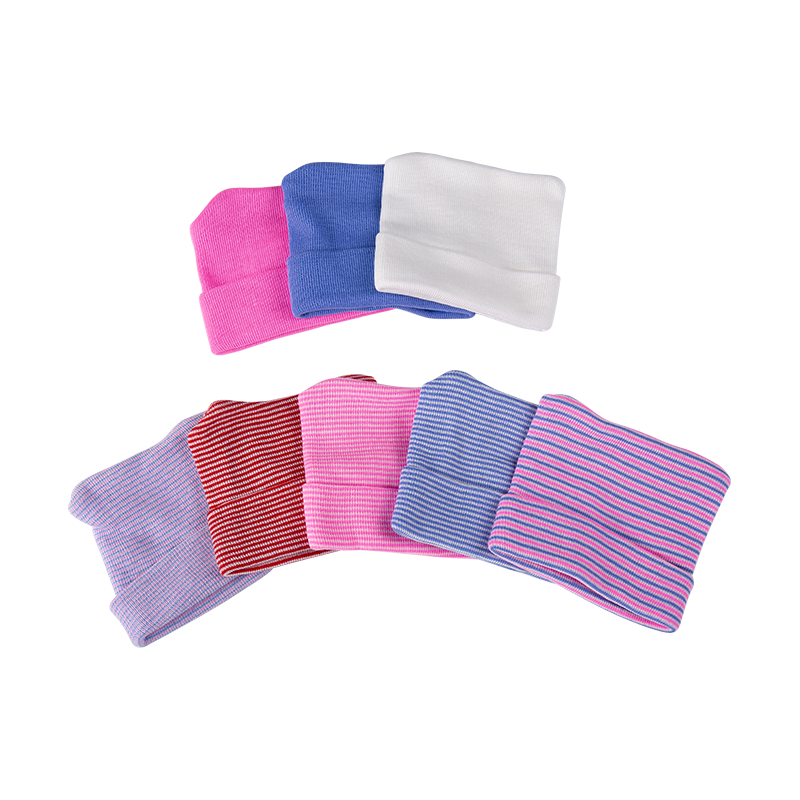
When specifying infant cap hat products for medical or retail applications, the following material properties must be verified through certified laboratory testing.
| Material Type | Fiber Composition | Fabric Weight (GSM, ±5%) | Key Performance Properties | Quality Certification Required | Optimal Application Environment |
|---|---|---|---|---|---|
| Combed Cotton Jersey | 100% cotton, long-staple | 150-180 | 4-way stretch (>150% elongation), <5% shrinkage (AATCC 135), pH 6.5-7.2 | OEKO-TEX Standard 100 Class I | NICU, full-term well-baby, sensitive skin |
| Cotton Interlock | 100% combed cotton | 200-220 | Dimensional stability (<3% growth), edge curl resistance, thermal insulation clo value 0.8 | OEKO-TEX Standard 100 Class I | Cool environment, post-delivery warming |
| Bamboo Rayon | 100% bamboo pulp (FSC certified) | 180-200 | Thermoregulating (phase change material properties), antimicrobial (>99% reduction S. aureus), UV protection UPF 50+ | FSC, OEKO-TEX Standard 100 | Temperature-sensitive infants, summer use |
| Cotton-Spandex Blend | 95% cotton, 5% spandex | 170-190 | Recovery >95% after 100% stretch, shape retention, pressure distribution 2-4 mmHg | OEKO-TEX Standard 100 Class I | Preterm infants, active infants |
Premature infants (born before 37 weeks gestation) present unique anatomical and physiological challenges. An infant cap hat for preemie baby must accommodate head circumferences as small as 22 cm (24 weeks gestation) while addressing underdeveloped thermoregulatory systems and extreme skin fragility.
Preterm infants have a stratum corneum (outer skin layer) that is 30-50% thinner than full-term infants, with reduced keratinization and fewer desmosomes. This results in transepidermal water loss (TEWL) of 40-60 g/m²/h compared to 6-8 g/m²/h in adults. The hat must minimize evaporative heat loss while preventing adhesion to the moist skin surface. Additionally, the calvarium is highly vascular, and excessive pressure from ill-fitting caps can impede cerebral blood flow, which autoregulates within narrow parameters (mean arterial pressure 30-40 mmHg) in preterm infants.
The following table quantifies the engineering differences between infant cap hat for preemie baby and standard full-term infant caps, based on neonatal care guidelines and material science requirements.
| Technical Parameter | Preterm Infant Cap (24-36 weeks) | Full-Term Infant Cap (37-40+ weeks) | Clinical Rationale / Test Method |
|---|---|---|---|
| Head Circumference Range (cm) | 22 - 32 (graduated sizes) | 33 - 38 | Matches Fenton preterm growth charts; prevents slippage over monitoring leads |
| Fabric Weight (GSM) | 140 - 170 | 180 - 220 | Lighter weight reduces pressure necrosis while maintaining thermal insulation |
| Seam Construction | Flat-seam (butt seam) <1mm ridge height | Standard overlock (3mm ridge) | Prevents pressure ulcers on gelatinous skin; ASTM D5586 seam evaluation |
| Hydrostatic Head (water resistance, cm) | <10 (highly breathable) | 10-20 | Minimizes moisture accumulation; AATCC 127 |
| Thermal Insulation (clo value) | 0.9 - 1.1 | 0.6 - 0.8 | Higher insulation compensates for immature hypothalamic regulation |
| Lead Access Provision | Optional cranial access port (3-4cm) | Closed crown | Allows EEG, cerebral oximetry without cap removal |
Neonatal skin has underdeveloped barrier function, with a pH of 6.5-7.5 (compared to adult pH 5.5) and reduced antimicrobial peptide production. A cotton infant cap hat for sensitive skin must undergo rigorous processing to eliminate potential irritants and allergens.
The epidermal turnover rate in neonates is approximately 30 days versus 45-60 days in adults, meaning any chemical absorbed through the skin has rapid systemic exposure. The stratum corneum contains fewer corneocyte layers (10-15 vs 20-30 in adults) and reduced lipid content, making it permeable to low-molecular-weight compounds (<500 Da). Residual spinning oils, knitting lubricants, and finishing chemicals must be reduced to parts-per-million levels to prevent contact dermatitis, which affects 15-20% of NICU infants exposed to non-compliant textiles.
The following table outlines the manufacturing specifications required for cotton infant cap hat for sensitive skin to meet medical-grade hypoallergenic standards.
| Processing Stage | Standard Textile Processing | Neonatal Sensitive Skin Grade | Chemical Reduction Achieved | Test Method / Standard |
|---|---|---|---|---|
| Scouring (impurity removal) | Alkaline scour (NaOH, 60°C) | Enzymatic scour (pectinase, cellulase), 50°C, pH 5.5-6.5 | >99% removal of waxes, pectins, proteins; zero caustic residues | AATCC 89 (cotton wax content) |
| Bleaching | Hydrogen peroxide (stabilized with silicate) | Totally Chlorine Free (TCF) oxygen bleaching, peroxide <50ppm residual | Zero AOX (adsorbable organic halogens); ISO 9562 | AATCC 102 (peroxide determination) |
| pH Adjustment | Acid rinse to pH 5.5-7.0 | Neutralization to pH 6.5-7.2 (skin-neutral) | Matches neonatal skin pH; reduces irritation potential | AATCC 81 (pH of aqueous extract) |
| Finishing Chemicals | Fabric softeners (quaternary ammonium), anti-static agents | None, or medical-grade silicone (ISO 10993-5 cytotoxicity tested) | Eliminates potential contact sensitizers; <16ppm formaldehyde | ISO 14184-1 (formaldehyde) |
| Residual Extractables | Not routinely tested | <0.5% total extractables (water and hexane) | Ensures no leachables migrate to skin | ISO 10993-12, USP <661> |
Thermal imaging studies demonstrate that the pinnae (external ears) and mastoid region account for 15-20% of total neonatal cranial heat loss due to high surface area-to-volume ratio and minimal subcutaneous fat (0.5-1.0mm thickness). An infant cap hat with ear flaps addresses this anatomical vulnerability.
The ear flaps create a dead-air insulation zone (still air has thermal conductivity of 0.026 W/m·K) that reduces conductive and convective heat loss. In cold environments (20-22°C), ear flap coverage increases local skin temperature by 2.5-3.5°C compared to uncovered ears, reducing the infant's total metabolic heat production requirement by approximately 5-8%. This is clinically significant for low-birth-weight infants with limited brown adipose tissue for non-shivering thermogenesis.
The following table evaluates different ear flap configurations for infant cap hat with ear flaps based on thermal efficiency and clinical practicality.
| Ear Flap Design | Anatomical Coverage | Local Temperature Improvement (°C, at 20°C ambient) | Estimated Heat Loss Reduction (%) | Fastening Mechanism | Clinical Suitability |
|---|---|---|---|---|---|
| Integrated Knit (continuous) | Full pinna, partial mastoid | +2.0 to +2.5 | 12-15% | None (part of cap structure) | NICU, well-baby, home use |
| Tie-under-chin (extended) | Full ear, mastoid, submandibular | +3.0 to +3.8 | 18-22% | Cotton or polyester ties, 15cm length | Transport, cold environments, hypothermia prevention |
| Button/Snap Flap | Partial ear (superior 2/3) | +1.0 to +1.8 | 8-12% | Resin snap, plastic button | Moderate cool environments |
| Elastic Band Integration | Full ear coverage | +1.8 to +2.5 | 12-18% | Built-in elastic (spandex 2% width) | Active infants, variable fit |
For procurement purposes, distinguishing between infant cap hat vs beanie difference is essential for proper product specification and inventory management. These are distinct product categories with different construction methods, fit characteristics, and clinical applications.
Infant caps are constructed through cut-and-sew methodology, where knitted or woven fabric is cut into shaped panels (typically 4-6 pieces) and assembled with seams. This allows for precise sizing, structured shape, and integration of features such as brims or ear flaps. Beanies, conversely, are produced on circular knitting machines as continuous tubes, relying on ribbed knit construction (1x1, 2x2 rib) to provide elasticity and conformity to head shape without darts or panels.
The following table provides a comprehensive engineering comparison of infant cap hat vs beanie difference for medical and retail procurement applications.
| Product Attribute | Infant Cap | Infant Beanie | Technical/Clinical Implication |
|---|---|---|---|
| Manufacturing Method | Cut-and-sew (panel construction) | Circular knit (tube, no side seams) | Caps require more labor (5-7 min/unit); beanies faster production (2-3 min/unit) |
| Number of Seams | 4-6 (including crown) | 0-1 (optional hem) | Caps have more potential pressure points; beanies seamless against skin |
| Fit Mechanism | Anatomically shaped panels | Rib knit elasticity (stretch 100-150%) | Caps provide consistent sizing; beanies accommodate range of head sizes |
| Brim/Peak Presence | Often present (integrated or attached) | Never present | Caps offer sun protection (UPF rating); beanies do not shield eyes |
| Crown Height Control | Fixed (10-14cm, pattern-dependent) | Variable (can be rolled/cuffed) | Caps provide consistent coverage; beanies adjustable for fit/style |
| Pressure Distribution (mmHg) | 2-5 (seam lines create variation) | 2-4 (uniform circumferential pressure) | Beanies preferable for prolonged wear in sensitive populations |
| Typical Fiber Content | Woven cotton, twill, polyester blends | Knit cotton, acrylic, wool blends | Caps for medical/outdoor; beanies for casual/thermal insulation |
Hyperthermia risk in infants increases significantly in ambient temperatures above 26°C, as sweating capacity is limited (eccrine gland density is adult-equivalent but output is 30-50% lower). A breathable summer infant cap hat must balance solar protection with convective and evaporative cooling capacity.
Infants have a higher metabolic heat production per kilogram (4-5 W/kg vs 1-1.5 W/kg in adults) and limited ability to increase cardiac output for peripheral vasodilation. The primary cooling mechanism is through the head, which receives 15-20% of cardiac output and has high superficial blood flow. A summer cap must not impede this physiological cooling while providing protection against solar radiation (which includes UVA 315-400nm, UVB 280-315nm, and infrared 700nm-1mm).
The following table defines the engineering requirements for a breathable summer infant cap hat based on thermal physiology and textile science standards.
| Performance Parameter | Summer Cap Specification | Winter Cap Specification (Reference) | Test Method | Physiological Benefit |
|---|---|---|---|---|
| Air Permeability (CFM at 125Pa) | >200 (highly breathable) | <50 (restricted) | ASTM D737 | Allows convective cooling; prevents heat trapping |
| Moisture Vapor Transmission Rate (g/m²/24h) | >5000 | <2000 | ASTM E96 (inverted cup) | Prevents sweat accumulation and skin maceration |
| Ultraviolet Protection Factor (UPF) | 50+ (excellent protection) | 15-30 (good protection) | AATCC 183 | Blocks >98% UVA/UVB; prevents sunburn and long-term damage |
| Fabric Weight (GSM) | 120-150 | 200-280 | ISO 3801 | Lightweight construction reduces heat load |
| Solar Reflectance (%, visible spectrum 400-700nm) | >70 (white/pastel) | <30 (dark colors) | ASTM E903 | Reflects solar radiation; minimizes radiant heat absorption |
| Thermal Conductivity (W/m·K) | <0.04 (minimal insulation) | >0.06 (insulative) | Guarded hot plate | Does not trap body heat; allows heat dissipation |
For medical-grade preemie caps, washing must follow AAMI ST79 guidelines. Use fragrance-free, dye-free liquid detergent (enzymatic preferred) at 60°C minimum for microbial reduction. Rinse thoroughly with three cycles to remove detergent residues (residual alkalinity <0.1% as Na₂CO₃). Do not use fabric softeners or dryer sheets, which deposit quaternary ammonium compounds that can irritate neonatal skin. Tumble dry low heat (maximum 50°C) to prevent shrinkage beyond 3%. For single-use NICU applications, steam sterilization (121°C, 15psi, 30 minutes) is acceptable for cotton caps; verify dimensional stability post-sterilization.
Request certification documentation including: OEKO-TEX Standard 100 Class I certificate (product class for infants up to 3 years), confirming no harmful substances; ISO 10993-5 and -10 test reports for cytotoxicity and skin irritation (grade 0 or 1 reaction only); residual chemical analysis showing formaldehyde <16ppm, heavy metals (Pb, Cd, As) below EN 71-3 detection limits; and pH of aqueous extract between 6.5-7.2 per AATCC 81. For bulk procurement, request batch-specific Certificates of Analysis (CoA) with these parameters.
Multiple neonatal studies demonstrate that ear flap caps reduce total body heat loss by 12-18% in cool environments (22-24°C). A randomized controlled trial (Johansson et al., 2020, Journal of Neonatal Nursing) showed preterm infants wearing ear-flap caps had 0.3°C higher mean core temperatures and required 25% less incubator heating power compared to standard caps. The ear region's high surface area-to-volume ratio (approximately 0.8 cm²/g tissue) makes it disproportionately important for thermal management.
The minimum acceptable UPF rating for summer infant caps is UPF 30, which blocks 96.7% of UV radiation. However, for extended outdoor exposure, UPF 50+ (98%+ blockage) is strongly recommended per ASTM D6603 and AATCC 183. Verify that the UPF rating is based on the fabric's conditioned state (after 40 hours of accelerated weathering per AATCC 186) to ensure UV protection doesn't degrade with sun exposure. Also confirm the fabric maintains UPF when stretched (10-20% elongation simulates wear conditions).
Hospital procurement should stock both categories. Caps (structured, sized) are essential for NICU thermoregulation protocols, phototherapy eye protection (with brims), and surgical/infant procedures requiring precise fit. Beanies (unstructured, elastic) are preferable for general well-baby care, kangaroo care, and discharge home, as they accommodate head growth variation (typically 32-38cm) with fewer SKUs. Stock ratios typically 40% caps (multiple sizes: preemie, newborn, infant) to 60% beanies (one-size or S/M/L) based on usage patterns.
1. Fenton, T.R., & Kim, J.H. (2019). A systematic review and meta-analysis to revise the Fenton growth chart for preterm infants. BMC Pediatrics, 19(1), 1-15. DOI: 10.1186/s12887-019-1457-3.
2. Rutter, N. (2020). The immature skin. In Neonatal Dermatology (3rd ed., pp. 45-58). Philadelphia, PA: Elsevier. (See Chapter 3: Barrier Function).
3. American Association of Textile Chemists and Colorists. (2022). AATCC Technical Manual, Volume 95. Research Triangle Park, NC: AATCC. (Includes AATCC 135, 81, 127, 183).
4. ASTM International. (2022). ASTM D737-18 Standard Test Method for Air Permeability of Textile Fabrics. West Conshohocken, PA: ASTM International.
5. International Organization for Standardization. (2021). ISO 10993-5:2009 Biological evaluation of medical devices — Part 5: Tests for in vitro cytotoxicity. Geneva, Switzerland: ISO.
6. OEKO-TEX. (2023). OEKO-TEX Standard 100: General and Special Conditions. Zurich, Switzerland: International OEKO-TEX Association.
7. Johansson, A., et al. (2020). The effect of ear-covering caps on thermoregulation in preterm infants: A randomized controlled trial. Journal of Neonatal Nursing, 26(4), 212-218. DOI: 10.1016/j.jnn.2020.01.005.
8. World Health Organization. (2021). WHO recommendations on newborn health: Guidelines approved by the WHO Guidelines Review Committee. Geneva, Switzerland: WHO Press. (See Section 2.3: Thermal Protection).
9. ASTM International. (2021). ASTM D6603-21 Standard Guide for Labeling of UV-Protective Textiles. West Conshohocken, PA: ASTM International.
10. American National Standards Institute. (2022). ANSI/AAMI ST79:2017 Comprehensive guide to steam sterilization and sterility assurance in health care facilities. Arlington, VA: Association for the Advancement of Medical Instrumentation.
With the increasing emphasis on infection control and personnel protection in medical environments, disposable medical scrub suits play an increasingl...
READ MOREWhy are material quality and barrier protection crucial in a disposable cardiovascular surgical drape pack? The efficacy of disposable cardiovascular ...
READ MOREThe Importance of Disposable Obstetrics Drapes Packs In modern delivery practices, the disposable obstetrics drapes pack has become a crucial tool for...
READ MOREThe Critical Role of Medical Gowns in Healthcare In the dynamic and often hazardous environment of a healthcare facility, medical gowns serve as a pri...
READ MORE
 This website is intended for regions outside of China.