
 English
 中文简体
 Español

Industry News
Home / News / Industry News / Disposable Isolation Gown Factory: Standards, Materials & Sourcing Checks


 By Admin
Content
Ask three disposable isolation gown factories to quote 200,000 gowns and the prices can differ by forty percent or more. The fabric alone rarely explains that gap. In most cases the difference sits in four places: cuff construction, seam type and stitch density, the level of fluid resistance the factory can actually document with dated test reports, and whether the supplier knits its own components or buys them from a trading partner. Narrowing those four variables turns a pile of quotations into a shortlist you can defend in front of a quality committee.
The sections below work through each variable in the order a sourcing team usually meets them, from the standard printed on the label to the questions that separate a manufacturer from a reseller.
An isolation gown looks simple, but a manufacturer makes a dozen decisions before the first metre of fabric is cut: substrate type (SMS, SMMS, spunlace or coated nonwoven), weight in grams per square metre, cut pattern, sleeve and cuff construction, collar style, waist tie placement, seam type, and packaging — cleanroom-bagged or bulk carton. Every choice shows up in both the unit price and the performance data a buyer is asked to accept.
SMS at 35 gsm and SMS at 45 gsm hang identically on a sample rack. Under a hydrostatic head test they behave like different products. That is why a serious quotation lists fabric weight, test method and acceptance criteria next to the price, and why a line reading only "SMS gown, 100,000 pcs" tells you almost nothing about what will arrive at your dock.
The protection claim on a gown is a test result, not a slogan. In the United States, ANSI/AAMI PB70 sorts gowns and drapes into four levels based on impact penetration and hydrostatic pressure, with viral penetration testing added at Level 4. In Europe, EN 13795 classifies products as standard or high performance using dry and wet tensile strength, hydrostatic resistance, microbial penetration and linting. The two frameworks do not map neatly onto each other, so a gown sold into both markets needs evidence for both.
| Classification | Core requirement | Typical clinical setting |
|---|---|---|
| AAMI PB70 Level 1 | Impact penetration no more than 4.5 g; no hydrostatic requirement | Basic patient care, visitor contact, minimal fluid exposure |
| AAMI PB70 Level 2 | Impact penetration no more than 1.0 g; no hydrostatic requirement | Blood draws, suturing, general ward activity |
| AAMI PB70 Level 3 | Impact penetration no more than 1.0 g; hydrostatic head at least 50 cm H2O | Arterial blood draws, IV insertion, emergency care |
| AAMI PB70 Level 4 | Hydrostatic head at least 140 cm H2O; passes ASTM F1671 viral penetration | Surgery and invasive procedures with heavy fluid exposure |
| EN 13795 standard performance | Lower tensile and hydrostatic thresholds; linting controlled | General care and routine procedures |
| EN 13795 high performance | Higher dry and wet tensile strength plus hydrostatic resistance | Surgical and high-fluid procedures |
Buyers usually get burned at the boundaries: a Level 2 gown described in a catalogue as "surgical", or a Level 3 product substituted for Level 4 in an emergency tender. The mismatch stays invisible until an audit or a complaint puts the claim under pressure. This breakdown of what actually determines an isolation gown's protection covers the test-by-test detail.
Three material families cover most of the market. Polypropylene SMS and SMMS dominate general isolation use; wood-pulp and spunlace blends trade strength for softness and breathability; coated or laminated fabrics appear where fluid resistance outranks comfort. Weight for isolation gowns generally lands between 25 and 45 gsm. Heavier fabric is not automatically safer — it is stronger and warmer, which is why a 45 gsm gown in a hot climate often becomes a compliance problem rather than a protection gain.
The cuff is where the decision gets interesting. An elastic band, a knitted cuff and a plain tie wrist behave differently across a four-hour shift. Knitted cuffs hold shape, seal without pinching and stay put through repeated glove changes, a detail nursing staff notice long before purchasing does.
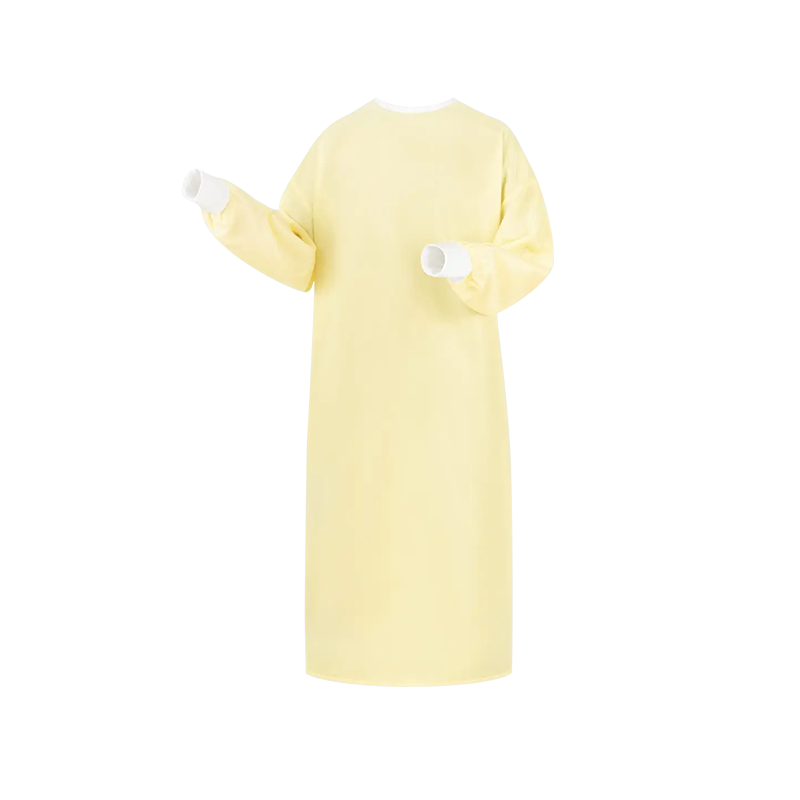 Disposable Isolation Gown with Knitted Cuff and Multiple Material OptionsCustom disposable isolation gown in SPP, SMS, or PP+PE, with knitted cuffs and sizes S-XXL for protection against splashes and infectious material.View Product →
Jiangsu Dingshun Medical Products Co., Ltd began in 2002 producing knitted cuffs and later expanded into disposable gowns, drapes and procedure packs. That sequence matters more than it sounds. The cuff is usually the first part of an isolation gown to fail: elastic fatigues, the seam puckers, or the knit loses recovery after sterilisation. A factory that knits its own cuffs and stockinette controls yarn, gauge and stretch recovery instead of accepting whatever the mill ships that month.
The same logic extends to TPE and waterproof elastic stockinette used as surgical pack accessories, where cuff tension and barrier continuity have to survive packaging, transport and a steam cycle.
 Custom Medical Knitted Cuff for Gowns and Surgical GownsSoft, tight knitted cuff component for medical and surgical gowns, offered in cotton, cotton-polyester, or polyester with multiple sizes.View Product →
One gown for an entire hospital is a procurement simplification, not a clinical strategy. Emergency triage, dialysis, isolation wards, maternity and sterile processing sit at different points on the barrier scale, and staff adherence depends partly on whether the gown stays wearable through a shift. A tie-back Level 4 gown is technically excellent and practically unwelcome in a busy isolation unit if it is hot, noisy or awkward to remove without self-contamination.
Hooded isolation gowns solve a narrower problem: contamination of the head, neck and shoulders during procedures with heavy spray, or when a clinician leans over an uncontained fluid source. They cost more per unit and earn that cost only where the exposure path is real.
 Hooded Isolation Gown with Elastic Cuffs and Full-Body CoverageCustom SMS or SF hooded isolation gown in white with elastic cuffs and sizes S-XXL, adding head and neck barrier coverage.View Product →
Before committing to a container, request and review:
These documents reveal capability faster than a factory tour video. A supplier that cannot produce a dated hydrostatic report for the exact fabric it quotes is asking you to carry its risk.
Unit price is the least useful number in a gown tender. The cost that reaches the ward includes freight, duties, packaging format, the labour of repacking into sterile bundles, and the share of units discarded for defects. A six percent cheaper gown with a three percent higher reject rate at incoming inspection can lose money before anyone wears it.
Confirm two practical figures early: the minimum order quantity per product code, since mixing sizes inside a code is not the same as mixing codes, and the lead time for repeat orders rather than first orders. First orders absorb sampling and artwork time; repeat orders reveal the factory's real production rhythm.
The conclusion is unglamorous. Choosing a disposable isolation gown factory is a documentation exercise before it becomes a price negotiation: match the barrier level to the intended clinical area, verify fabric weight and cuff construction, and confirm that components are made under the same roof as the gown. Suppliers with that paper trail, including Jiangsu Dingshun Medical Products, which has served customers in more than 33 countries across North America, Europe, Japan and Korea since 2002, tend to be the ones whose samples match their shipments. Start with the company's product range, then request specifications before quotations.
With the increasing emphasis on infection control and personnel protection in medical environments, disposable medical scrub suits play an increasingl...
READ MOREWhy are material quality and barrier protection crucial in a disposable cardiovascular surgical drape pack? The efficacy of disposable cardiovascular ...
READ MOREThe Importance of Disposable Obstetrics Drapes Packs In modern delivery practices, the disposable obstetrics drapes pack has become a crucial tool for...
READ MOREThe Critical Role of Medical Gowns in Healthcare In the dynamic and often hazardous environment of a healthcare facility, medical gowns serve as a pri...
READ MORE
 This website is intended for regions outside of China.