
 English
 中文简体
 Español

Industry News
Home / News / Industry News / Custom Reusable Isolation Gown Sourcing: Specs, Fabrics, and Laundering Guide


 By Admin
Content
A 300-bed hospital asks for 2,000 custom reusable islation gowns, usually written as reusable isolation gowns, in navy, with a logo, knitted cuffs, and ties. The first quote looks competitive. After 30 industrial wash cycles, seams wick, ties fray, and size labels no longer match the fit. The problem is not price. It is the specification.
The conclusion is simple: lock performance before appearance. If you choose color and logo first, the supplier may pick the cheapest fabric and closure that meet the visual brief. Start with the clinical task, then the barrier level, then laundering method, then pattern and trims. Only then discuss logo, color, and packaging.
A disposable isolation gown is used once. A reusable gown must survive industrial laundering, hold its barrier, keep its shape, and stay comfortable enough to wear correctly. Customization adds risk: fabric weight, color, neckline, cuffs, ties, pockets, size range, and logo all become your specification.
For isolation gowns, the benchmark is AAMI PB70. It classifies liquid barrier performance from Level 1 to Level 4. Many reusable isolation gowns target Level 1 or Level 2, while higher levels are usually for surgical or fluid-intensive tasks. Ask for test evidence on fabric and critical seam and closure areas, not just a generic fabric certificate. If a reusable gown has no laundering-cycle data, treat the claim as unverified.
Fabric determines barrier, breathability, drape, laundering life, and cost. Common choices include 100% polyester, polyester-cotton blends, and micro-denier polyester with a fluid-repellent finish. Weight usually falls between 120 and 180 gsm, but weight alone does not prove barrier performance. A 150 gsm fabric with a weak finish may fail sooner than a 130 gsm fabric with a stable weave and durable finish.
| Fabric option | Typical weight | Barrier and comfort notes | Best fit |
|---|---|---|---|
| 100% polyester | 120–160 gsm | Good durability and color retention; breathability varies by weave and finish. | General isolation, long wash cycles, clear color coding. |
| Polyester-cotton blend | 140–180 gsm | Softer hand feel and comfort; may shrink more if not pre-shrunk. | Comfort-focused wards, moderate laundering cycles. |
| Micro-denier polyester | 130–170 gsm | Dense weave can improve liquid resistance; tends to be softer and lighter. | Higher perceived comfort, Level 2 isolation targets. |
| Fluid-repellent finished blend | 140–180 gsm | Finish drives performance; must be revalidated after repeated washing. | Areas with higher splash or spray exposure. |
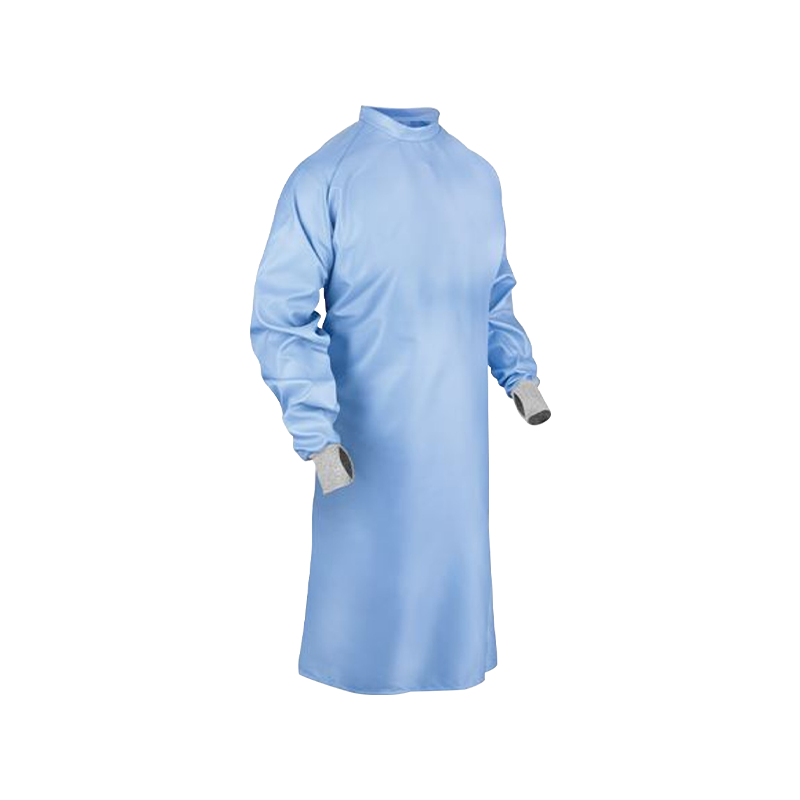 Reusable Isolation Gown with Knitted Cuffs and Autoclavable DesignReusable isolation gown in blue polyester filament with knitted cuffs, S–XXL, designed for fluid and particulate barrier protection across hospital and lab use.View Product →
Ask for fabric test reports, shrinkage data, colorfastness results, and laundering cycle details. If you need a custom color, confirm that the dye will not bleed into other hospital linen. For a deeper look at breathability and standards, see reusable isolation gown fabrics, breathability, and standards. The goal is the lightest fabric that still meets the required barrier after the expected number of washes.
Small trims cause large complaints. Ties are inexpensive but can fray, knot, or pull loose. Snaps and hook-and-loop closures are faster to don but must survive repeated laundering without cracking or losing grip. Knitted cuffs give a secure wrist seal, but the cuff must match sleeve length and wash temperature. Hooded versions add fabric, seams, and fit complexity.
Fit is clinical. Too short and the front opening or waist can expose scrubs. Too tight and staff may not close it properly. Too loose and sleeves catch on equipment. Custom sizes need a clear chart with tolerance ranges for chest, length, sleeve, and cuff. When you review a sample, test donning and doffing with gloves, then wash it five to ten times and check the same points again.Reusable isolation gowns go through industrial laundry cycles with controlled temperature, detergent chemistry, mechanical action, and drying. A gown that passes one wash test may fail at 50 cycles. A useful validation plan tracks barrier performance, seam strength, closure function, shrinkage, color change, and linting at 0, 25, 50, and 75 cycles. Match the cycle count to your expected reuse life.
If the supplier cannot answer laundry questions, the custom gown is not ready for scale. Document validation in the technical file. Custom logo and color also need checking after washing, because some inks and dyes fade or transfer.
Once the design is fixed, sourcing becomes a control exercise. A custom reusable isolation gown order should include an approved sample, a written specification, a test plan, and a change-control clause. The specification should state fabric composition, weight tolerance, barrier level, seam type, stitch density, closure type, size range, color tolerance, logo method, and packaging. Without tolerances, every shipment can be argued as close enough.
Use a pre-production sample approval process. The sample should be made on the same line, with the same fabric lot and trims, as the bulk order. Check measurements flat and on a fit model. Confirm logo placement after folding and packing. Ask for batch traceability from fabric roll to finished carton.
The most common risk is buying on unit price alone. A lower-priced gown may use lighter fabric, shorter ties, or weaker seams. Other risks include inconsistent sizing, color transfer, closure failure after 20 washes, and missing documentation. Request a written report for every claim. Fluid repellent should come with a test method and result. Reusable should come with a cycle count. If the supplier cannot provide documentation, simplify the customization or choose another supplier.
Start with the task. General isolation may need only Level 1 or Level 2. Splash or spray exposure may require a higher barrier. Then choose the laundering method and cycle target, then fabric weight and finish, then closure and fit. Add color, logo, and packaging last.
A custom reusable isolation gown supplier should act as a technical partner, not just a sewing factory. Jiangsu Dingshun Medical Products Co., Ltd produces reusable and hooded isolation gowns alongside surgical packs, drapes, and medical knitting. The final check is simple: can the supplier show a washed sample, a test report, and a stable size chart? If yes, you have a workable program. If no, keep the specification open until the evidence is complete.
With the increasing emphasis on infection control and personnel protection in medical environments, disposable medical scrub suits play an increasingl...
READ MOREWhy are material quality and barrier protection crucial in a disposable cardiovascular surgical drape pack? The efficacy of disposable cardiovascular ...
READ MOREThe Importance of Disposable Obstetrics Drapes Packs In modern delivery practices, the disposable obstetrics drapes pack has become a crucial tool for...
READ MOREThe Critical Role of Medical Gowns in Healthcare In the dynamic and often hazardous environment of a healthcare facility, medical gowns serve as a pri...
READ MORE
 This website is intended for regions outside of China.