
 English
  中文简体
中文简体  Español
Industry News
With the increasing emphasis on infection control and personnel protection in medical environments, disposable medical scrub suits play an increasingl...
READ MORE

 By Admin
Content
Healthcare procurement teams face critical decisions when selecting personal protective equipment (PPE) that balances infection control efficacy, operational sustainability, and economic viability. Reusable isolation gown systems have experienced renewed clinical interest driven by supply chain resilience imperatives, waste reduction mandates, and lifecycle cost optimization. This technical guide examines material engineering, protective performance standards, and implementation protocols for healthcare facility decision-makers.
Jiangsu Dingshun Medical Products Co., Ltd. was established in 2002, beginning with knitted cuffs and evolving into comprehensive disposable medical consumables manufacturing. Over two decades, our product portfolio has expanded to encompass stockinette, surgical packs, bandages, and isolation protection systems. Products are distributed across 33 countries and regions including North America, Europe, Japan, and South Korea. Our organization adheres to quality-first principles with full-process management from raw material selection through final distribution, while committed to introducing new technology to global healthcare markets. Our corporate vision drives continuous advancement: "For doctors, For us, and For future. We are forward moving."
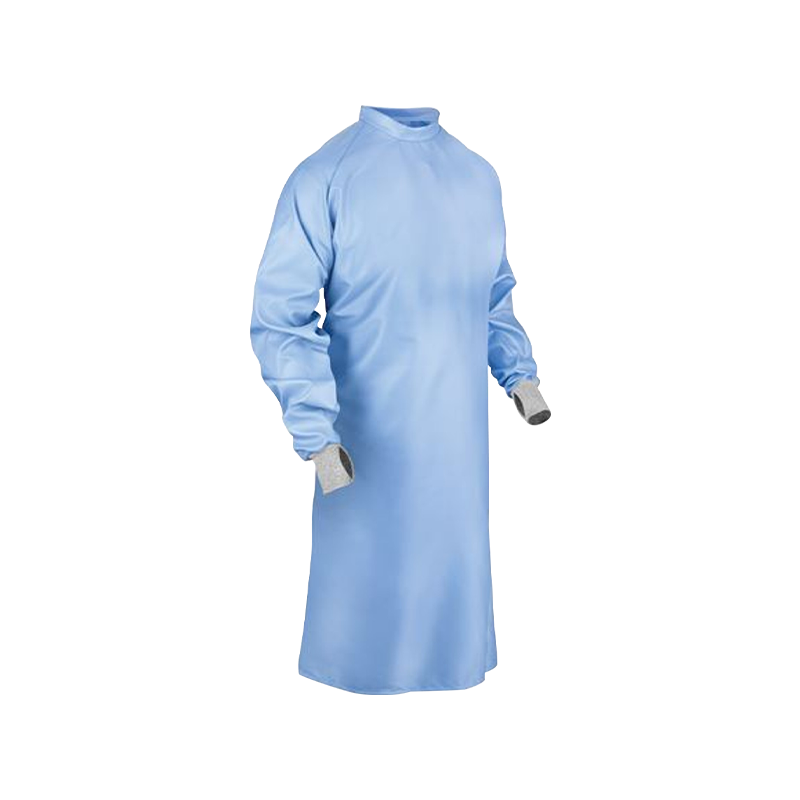
The fundamental distinction between reusable isolation gown systems and single-use alternatives lies in material architecture, durability engineering, and end-of-life processing requirements. These differences cascade through procurement economics, environmental impact, and clinical workflow design.
Reusable isolation gowns utilize woven or knitted textile substrates engineered for multiple processing cycles. Standard constructions incorporate polyester-cotton blends (65/35 or 80/20) or 100% polyester microfiber weaves with filament counts optimized for tear resistance and dimensional stability. Barrier functionality is achieved through tight weave architectures (minimum 120 threads per inch), repellent chemical finishes, or laminated membrane systems.
Comparative material analysis reveals performance differentiators:
| Property | Reusable Isolation Gown (Polyester Microfiber) | Disposable Isolation Gown (SMS Polypropylene) | Clinical Implication |
| Basis weight (gsm) | 120-180 | 25-60 | Reusable provides superior substance and durability |
| Tear resistance (N, ASTM D1424) | 25-35 | 8-12 | Reusable withstands mechanical stress during extended procedures |
| Wash cycles to failure | 50-100 | 1 (single use) | Reusable amortizes environmental impact across multiple uses |
| Fluid repellency duration | 50-75 washes (with retreatment) | Single exposure | Reusable requires monitoring and retreatment protocols |
| Breathability (RET value) | 6-12 m²Pa/W | 3-8 m²Pa/W | Disposable generally more breathable; reusable acceptable for extended wear |
| End-of-life processing | Industrial recycling possible | Medical waste incineration/landfill | Reusable reduces regulated medical waste volume 60-80% |
| Unit cost per use (at 75 cycles) | $0.40-0.80 | $2.50-5.00 | Reusable achieves 70-85% cost reduction at scale |
Critical to reusable system viability is understanding performance decay through processing cycles. AAMI PB70 Level 2 gowns must maintain hydrostatic resistance of ≥20 cm H₂O and impact penetration resistance of ≤4.5g. Studies demonstrate:
Barrier protection requirements for isolation gowns are codified in AAMI PB70:2012, which establishes four performance levels based on liquid barrier testing. Washable reusable isolation gown AAMI level 2 represents the predominant specification for low-to-moderate risk healthcare environments.
The Association for the Advancement of Medical Instrumentation standard classifies gowns based on ability to resist liquid penetration under simulated use conditions:
Washable reusable isolation gown AAMI level 2 achieves certification through:
Level 2 reusable gown performance validation:
| Test Method | Performance Requirement | As-New Reusable Gown | After 50 Wash Cycles | Pass/Fail Criteria |
| AATCC 127 Hydrostatic resistance | ≥20 cm H₂O | 45-65 cm | 25-40 cm | Must maintain ≥20 cm |
| AATCC 42 Impact penetration | ≤4.5g penetration | 1.0-2.5g | 2.5-4.0g | Must maintain ≤4.5g |
| IST 160.01 Synthetic blood penetration | No penetration at 2 psi | Pass | Pass (with retreatment) | No penetration observed |
| ASTM D751 Burst strength | Not specified in AAMI | 200-300 psi | 150-250 psi | Monitor for structural integrity |
Higher protection levels present significant engineering challenges for reusable systems. Level 3 requirements (≥50 cm H₂O) typically demand membrane laminates or specialized coatings that degrade under repeated thermal and chemical processing. Level 4 viral barrier performance (ASTM F1671) utilizing hydrostatic pressure challenge with Phi-X174 bacteriophage is rarely achievable in reusable formats due to seam sealing requirements.
Current technological approaches for high-level reusable protection:
Clinical acceptance of reusable isolation gown for healthcare workers depends on comfort engineering that supports extended wear without compromising protective integrity. Human factors design addresses thermal comfort, mobility requirements, and contamination control during doffing.
Healthcare workers frequently report thermal discomfort as a primary PPE compliance barrier. Reusable gown designs manage heat stress through:
Comparative thermal comfort analysis:
| Parameter | Reusable Gown (Microfiber) | Disposable Gown (SMS) | Reusable Gown (Cotton Blend) |
| RET value (breathability) | 8-12 | 4-8 | 15-25 |
| Moisture vapor transmission (g/m²/24h) | 2500-4000 | 4000-6000 | 6000-10000 |
| Surface temperature at skin (°C, after 2h wear) | 31-33 | 30-32 | 32-34 |
| Subjective comfort rating (1-5 scale) | 3.5-4.0 | 3.0-3.5 | 4.0-4.5 |
| Protection level (AAMI) | Level 2-3 | Level 1-3 | Level 1-2 |
Proper fit ensures protective coverage while enabling safe doffing procedures. Engineering specifications include:
Successful reusable system implementation depends on validated reusable isolation gown industrial laundering protocols that ensure infection control while preserving textile barrier properties. Healthcare laundering operates under stringent regulatory oversight distinct from commercial textile processing.
Healthcare-grade laundering achieves hygienic cleanliness through synergistic thermal and chemical action:
Processing technology comparison:
| System Type | Batch Size (kg) | Cycle Time (min) | Water Consumption (L/kg) | Energy Consumption (kWh/kg) | Validation Documentation |
| Single-chamber washer-extractor | 20-100 | 45-60 | 15-25 | 0.4-0.6 | Temperature logs |
| Continuous batch washer (tunnel) | 500-2000 | 30-40 | 8-12 | 0.3-0.4 | Automated monitoring |
| Hygiene barrier washer (split drum) | 10-30 | 50-70 | 20-30 | 0.5-0.8 | Full parameter tracing |
| On-site hospital laundry | Variable | Variable | Variable | Variable | Internal QA/QC |
| Third-party healthcare laundry | Industrial scale | Optimized | 6-10 (recycled water) | 0.25-0.35 | Certified to EN 14065/RABC |
Industrial washing chemistry impacts long-term barrier functionality:
Healthcare procurement decisions increasingly incorporate total cost of ownership (TCO) and environmental impact assessments. Reusable isolation gown vs disposable cost analysis demonstrates significant economic advantages at scale, while reusable isolation gown life cycle assessment quantifies environmental benefits.
Comprehensive cost analysis extends beyond unit purchase price to encompass system-wide economics:
Cost comparison at 10,000 gown uses per month:
| Cost Component | Disposable System (10,000 uses) | Reusable System (135 gowns × 75 cycles) | Cost Differential |
| Gown acquisition | $35,000 ($3.50 avg) | $4,725 ($35 avg) | -87% |
| Storage and inventory | $2,500 (warehouse space) | $500 (compact inventory) | -80% |
| Distribution labor | $1,500 (daily restocking) | $300 (weekly exchange) | -80% |
| Laundering/processing | N/A | $10,125 (75 cycles @ $1.00) | New cost |
| Waste disposal | $3,500 (regulated medical waste) | $350 (10% disposal rate) | -90% |
| Total monthly cost | $42,500 | $16,000 | -62% |
| Annual savings | Baseline | $318,000 | 62% reduction |
Reusable isolation gown life cycle assessment following ISO 14040 methodology demonstrates environmental superiority:
Environmental metrics per 1,000 uses:
| Impact Category | Disposable Polypropylene Gowns | Reusable Polyester Gowns (75 cycles) | Reduction |
| CO₂-equivalent emissions (kg) | 450-550 | 120-160 | 70-75% |
| Water consumption (L) | 18,000-25,000 | 6,000-10,000 | 55-70% |
| Non-renewable energy (MJ) | 8,500-11,000 | 2,500-3,500 | 65-75% |
| Regulated medical waste (kg) | 150-200 | 2-4 | 98-99% |
| Abiotic depletion potential | High (petroleum feedstock) | Moderate (polyester synthesis) | 60% (with recycling option) |
Reusable medical textiles operate under complex regulatory frameworks addressing device classification, biocompatibility, and processing validation.
In the United States, isolation gowns are regulated as Class I or II medical devices depending on barrier claims:
European Union Medical Device Regulation (MDR) 2017/745 classifies reusable surgical gowns as Class I devices with specific requirements for:
Industrial laundering for healthcare operates under quality management systems:
Transition from disposable to reusable isolation gown systems requires structured project management addressing clinical acceptance, supply chain modification, and infection control validation.
Successful implementation strategies include:
Reusable system logistics differ fundamentally from disposable supply chains:
Validated reusable isolation gown systems maintain AAMI PB70 Level 2 performance through 50-75 industrial wash cycles when processed according to manufacturer specifications. Cycle life depends on fabric construction, processing chemistry, and monitoring protocols. Microfiber polyester weaves with inherent barrier properties achieve longer cycle life (75-100 cycles) compared to treated cotton-polyester blends (50-75 cycles) where fluorocarbon finishes require periodic renewal. Critical to cycle life validation is implementation of tracking systems monitoring individual gown history and retirement at predetermined cycle counts regardless of apparent condition. Facilities should establish 50-cycle minimum performance guarantees with suppliers and conduct quarterly sampling verification testing.
Washable reusable isolation gown AAMI level 2 is appropriate for COVID-19 care in low-to-moderate exposure scenarios per CDC and WHO guidance. Level 2 gowns provide adequate protection against respiratory droplet transmission during routine patient care, medication administration, and environmental cleaning in non-aerosol generating situations. COVID-19 virus is susceptible to standard laundry disinfection protocols (71°C/160°F for 25 minutes or appropriate chemical disinfection). However, aerosol generating procedures (intubation, bronchoscopy, open suctioning) require Level 3 or 4 protection potentially exceeding reusable gown capabilities. Facilities should conduct point-of-care risk assessments determining appropriate protection levels based on anticipated exposure intensity, procedure type, and patient viral load status.
Financial payback for reusable isolation gown vs disposable cost analysis typically achieves break-even within 6-12 months depending on facility size and utilization patterns. Initial capital investment includes gown procurement ($25-45 per unit), par level inventory establishment (3-5x daily usage), and potential laundry infrastructure modification. Operational cost savings of 60-75% per use cycle generate rapid return: a 500-bed hospital converting 50,000 monthly gown uses realizes annual savings of $1.5-2.0 million after processing costs. Smaller facilities (100-200 beds) achieve payback in 12-18 months due to economies of scale in laundry processing. Third-party laundry services eliminate capital requirements, improving cash flow for smaller organizations. Total cost of ownership analysis should incorporate 5-7 year lifecycle projections including gown replacement, processing inflation, and waste disposal cost escalation.
Reusable isolation gown industrial laundering achieves infection control equivalence through validated thermal and chemical disinfection processes. Healthcare-grade laundries operate under EN 14065 or HLAC standards requiring documented bioburden reduction. Thermal disinfection at 71°C (160°F) for minimum 25 minutes achieves >5 log₁₀ reduction of vegetative bacteria, viruses, and fungi. Chlorine-based chemistry (50-150 ppm) provides sporicidal efficacy and addresses bloodborne pathogens. Validation protocols include microbiological sampling of processed textiles, environmental monitoring of laundry facilities, and traceability documentation. Studies demonstrate that properly laundered reusable gowns present lower bioburden than newly manufactured disposable gowns, which may harbor manufacturing debris and packaging contaminants. The critical control point is adherence to validated processing parameters; deviations in temperature, chemistry, or mechanical action compromise disinfection efficacy.
Effective life cycle management requires automated tracking systems monitoring individual gown utilization and retirement. RFID (Radio Frequency Identification) technology embeds washable tags in gown hems or labels, enabling automated cycle counting through laundry processing tunnels or manual scanning stations. Barcode systems offer lower-cost alternatives requiring manual scanning at distribution and collection points. Cloud-based database systems integrate with hospital inventory management, triggering alerts at 80% of rated cycle life (e.g., 60 cycles for 75-cycle rated gowns) and automatic retirement at cycle limit. Advanced systems incorporate visual inspection documentation, repair tracking, and quality hold functionality for stained or damaged items. Implementation costs range $0.50-2.00 per gown for RFID systems versus $0.10-0.30 for barcode systems, with ROI achieved through prevented use of degraded gowns and automated inventory optimization.
Specification of reusable isolation gown systems requires comprehensive analysis of protection requirements, processing infrastructure, economic parameters, and sustainability objectives. The five critical variants examined—washable reusable isolation gown AAMI level 2, reusable isolation gown for healthcare workers, reusable isolation gown life cycle assessment, reusable isolation gown industrial laundering, and reusable isolation gown vs disposable cost analysis—demonstrate the technical maturity and operational viability of textile-based PPE in modern healthcare environments.
Successful implementation demands partnership with vertically integrated manufacturers possessing textile engineering expertise, quality management certifications, and global distribution capabilities. Jiangsu Dingshun Medical Products Co., Ltd. leverages two decades of medical textile manufacturing experience to deliver reusable isolation protection systems meeting international standards while advancing sustainable healthcare practices. Our commitment to quality-first manufacturing and continuous innovation supports healthcare facilities in achieving infection control excellence with environmental responsibility.
With the increasing emphasis on infection control and personnel protection in medical environments, disposable medical scrub suits play an increasingl...
READ MOREWhy are material quality and barrier protection crucial in a disposable cardiovascular surgical drape pack? The efficacy of disposable cardiovascular ...
READ MOREThe Importance of Disposable Obstetrics Drapes Packs In modern delivery practices, the disposable obstetrics drapes pack has become a crucial tool for...
READ MOREThe Critical Role of Medical Gowns in Healthcare In the dynamic and often hazardous environment of a healthcare facility, medical gowns serve as a pri...
READ MORE
 This website is intended for regions outside of China.