
 English
  中文简体
中文简体  Español
Industry News
Home / News / Industry News / How to Choose Between Disposable and Reusable Medical Gowns for Your Facility?


 By Admin
Content
In healthcare facilities, protective apparel serves as a critical barrier against infectious agents. The selection of appropriate medical gowns directly impacts infection control outcomes, staff safety, and operational budgets. For procurement specialists, infection control directors, and wholesale buyers, understanding the technical distinctions between disposable and reusable options is essential. The category of Disposable Reusable Medical Gowns encompasses two fundamentally different product classes, each with distinct material science, barrier performance, and lifecycle cost structures. This article provides an engineer-level analysis of fabric technologies, testing standards, and economic factors to support informed B2B purchasing decisions.
Medical gowns fall into two primary categories based on intended use cycle. The disposable medical gown for surgical settings utilizes nonwoven fabrics engineered for single-use applications. These materials typically consist of polypropylene, polyethylene, or composite laminates. The reusable isolation gown for hospitals employs woven or knit fabrics, commonly polyester, cotton blends, or microfiber materials, designed to withstand multiple laundering cycles. Each category employs distinct manufacturing processes that affect barrier properties, comfort, and durability.
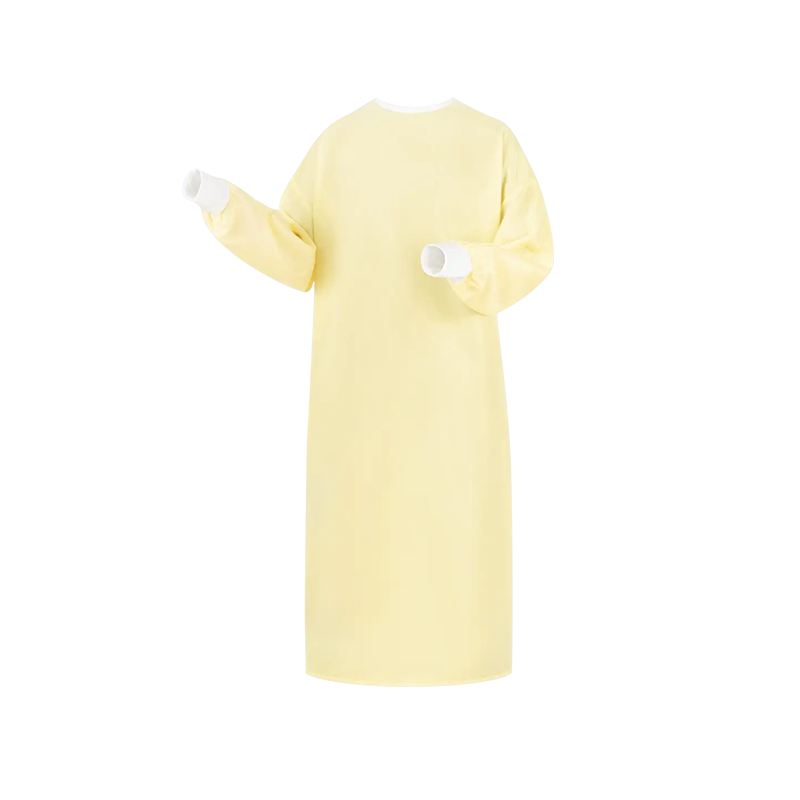
Engineers must assess several material characteristics when specifying gowns. The following list outlines critical technical parameters.
Regulatory compliance is paramount in medical apparel selection. The Association for the Advancement of Medical Instrumentation (AAMI) defines four levels of barrier protection. When evaluating Disposable Reusable Medical Gowns, buyers must verify AAMI level certification per ANSI/AAMI PB70 standards. This classification system provides objective performance data for procurement decisions.
Barrier Performance Comparison by Material Type
| Parameter | Disposable (SMS Nonwoven) | Reusable (Polyester Woven) |
|---|---|---|
| AAMI Level Range | Levels 1 through 4 are available | Level 1 through Level 3 typical; Level 4 limited availability |
| Fluid Resistance (Water Impact Penetration) | 0.1 - 50 cm H₂O pressure range | 0.1 - 20 cm H₂O pressure range |
| Hydrostatic Head Test Result | ≥ 100 cm H₂O for Level 4 | ≥ 50 cm H₂O for Level 3 |
| Breathability (MVTR) | 300 - 1500 g/m²/24hr | 800 - 2000 g/m²/24hr |
| Tensile Strength | 15 - 30 N/cm (machine direction) | 200 - 400 N/cm |
Surgical applications require sterile gowns delivered in validated packaging. The sterile surgical gown disposable undergoes gamma irradiation or ethylene oxide sterilization processes. These gowns are individually packaged with sterility assurance levels (SAL) of 10⁻⁶. Reusable surgical gown sterile processing relies on facility-based sterilization through autoclaving or hydrogen peroxide plasma systems. Each approach has distinct quality control requirements and sterility maintenance considerations.
For procurement managers, the total cost of ownership provides the most accurate economic comparison. The disposable vs reusable medical gown cost comparison involves evaluating purchase price, usage frequency, processing costs, and replacement rates. A comprehensive TCO model reveals that higher initial investment in reusable systems may yield lower per-use costs for high-volume facilities with established laundry infrastructure.
Total Cost of Ownership Comparison (Per 100 Gown Uses)
| Cost Component | Disposable System | Reusable System |
|---|---|---|
| Initial Product Cost | $1.50 - $5.00 per unit | $15.00 - $40.00 per unit (capital) |
| Laundry Processing Cost | Not applicable | $0.75 - $1.50 per cycle |
| Waste Disposal Cost | $0.25 - $0.50 per unit | Minimal (end-of-life only) |
| Inventory Carrying Cost | Higher (large volume storage) | Lower (rotating inventory) |
| Cost Per Use (100 uses) | $175 - $550 | $90 - $190 (including processing) |
Healthcare facilities increasingly evaluate environmental footprint when making procurement decisions. The eco-friendly reusable medical gown offers reduced waste generation when managed properly. Life cycle assessment studies indicate reusable gowns generate 28% to 40% less greenhouse gas emissions compared to disposable alternatives when factoring in manufacturing, transportation, laundering, and disposal phases. However, water consumption and chemical usage in laundering represent significant environmental considerations.
Healthcare supply chain professionals prioritize inventory strategies that ensure consistent availability. The bulk disposable medical gown wholesale model requires significant warehouse space but offers immediate availability. The reusable gown model relies on par-level management and in-house or contracted laundry services. During supply chain disruptions, facilities with reusable programs maintain operational capability independent of manufacturer production schedules.
Quality assurance programs must verify ongoing product performance. Disposable gowns require incoming inspection to confirm lot conformity to certified standards. Reusable gowns require ongoing inspection programs to monitor barrier degradation after repeated laundering. Facilities must implement gown inspection protocols that identify worn fabric, compromised seams, and diminished fluid repellency.
Level 4 barrier protection is required for surgical procedures with high fluid exposure, including orthopedic surgery, cardiovascular procedures, and trauma surgery. Level 3 is acceptable for minor surgical procedures and interventional radiology. The facility's infection control committee should establish specific requirements based on procedure risk classification per AORN guidelines.
Manufacturers validate reusable gowns for specific cycle counts, typically ranging from 50 to 100 industrial laundering cycles. Actual usable life depends on laundering protocols, sterilization methods, and fabric construction. Facilities should implement cycle tracking systems and conduct periodic barrier testing to determine replacement timing. High-temperature autoclaving reduces fabric life compared to low-temperature hydrogen peroxide sterilization.
Clean, unused disposable gowns may be recyclable through manufacturer take-back programs. Used gowns are considered regulated medical waste if contaminated and require proper disposal. Emerging technologies for recycling polypropylene from used gowns exist, but are not widely available commercially. Most healthcare facilities dispose of used disposable gowns through waste-to-energy or landfill pathways.
Procurement specifications should require FDA 510(k) clearance for surgical gowns, ANSI/AAMI PB70 certification with documented test results, and ISO 13485 quality management system certification. For reusable gowns, require validation data for laundering cycles and sterilization compatibility. Disposable gowns require sterility assurance documentation and lot traceability. All suppliers should provide certificates of analysis for each production lot.
With the increasing emphasis on infection control and personnel protection in medical environments, disposable medical scrub suits play an increasingl...
READ MOREWhy are material quality and barrier protection crucial in a disposable cardiovascular surgical drape pack? The efficacy of disposable cardiovascular ...
READ MOREThe Importance of Disposable Obstetrics Drapes Packs In modern delivery practices, the disposable obstetrics drapes pack has become a crucial tool for...
READ MOREThe Critical Role of Medical Gowns in Healthcare In the dynamic and often hazardous environment of a healthcare facility, medical gowns serve as a pri...
READ MORE
 This website is intended for regions outside of China.