
 English
 中文简体
 Español

Industry News
Home / News / Industry News / Delivery Pack Factory: What to Check Before You Place a Sterile Kit Order


 By Admin
Content
A
A delivery pack reaches the delivery suite with one underpad missing, a fenestration sitting 3 cm off the obstetrician's usual field, or leg sleeves that tear when stretched over a lithotomy stirrup — and the room stalls while someone hunts for a replacement. Those failures are rarely the hospital's fault. They are set months earlier, when the kit list was written and the supplier was chosen.
Short version: screen a delivery pack factory on four points before anyone mentions price — ownership of knitting and sewing, drape and barrier test data behind the printed claim, a pack list that mirrors your unit's actual workflow, and batch records that hold up under audit. The rest of this article explains why each one changes what lands in your storeroom.
What a Delivery Pack Factory Actually Ships
An obstetric delivery pack is a sterile, single-use assembly: drapes, absorbent pads, gowns, and small procedural consumables packed in a defined sequence so the midwife or scrub nurse can open it in layers without contaminating the field. The factory's job is not simply to fold drapes. It is to hold a fixed bill of materials, verify every incoming component, and reproduce the same kit, batch after batch, for years.
Specification problems usually surface in the small items rather than the headline drape. Request a component-level pack list showing material, weight in GSM, and dimensions for each line, then compare it against how your unit genuinely works.
|
Component |
Typical construction |
Why it matters in the room |
|
Fenestrated perineal drape |
SMS nonwoven, 60–90 cm fenestration |
Fenestration size and adhesive edge decide whether the field stays dry |
|
Absorbent underpad |
PE film with tissue and pulp core |
Fluid hold across a long second stage; thin pads soak straight through |
|
Back table cover |
Reinforced SMS, 70–100 g/m² |
Weight and puncture resistance for loaded instrument trays |
|
Baby wrap and infant cap |
Knitted cotton or soft nonwoven |
Heat retention in the first minutes after birth |
|
Leg sleeves or stockinette |
Knitted cotton or elastic TPE |
Must stretch over stirrups and calves without tearing at the seam |
|
Cord clamp, gauze, bulb syringe |
Purchased and repacked components |
A missing item halts the procedure faster than any drape defect |
Two lines on that list deserve scrutiny. First, absorbent capacity: a 30 g/m² underpad and a pulp-cored pad behave very differently during a prolonged second stage. Second, elastic range on leg sleeves and knitted tube components — specified too tight and they split at the seam, too loose and they will not stay over the calf.
.
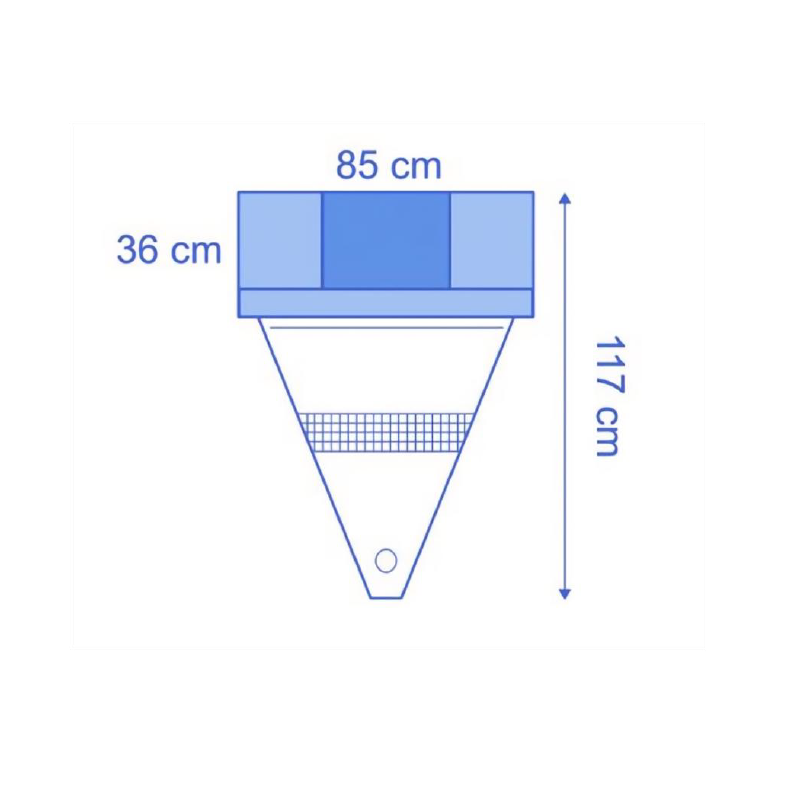 Custom Obstetric Delivery Pack for Natural DeliveryCustomizable natural-delivery pack with under-buttocks and side drapes, leggings, gown, and umbilical clamp; check the listed contents and request a quote.View Product →
A factory quoting a single price for "an obstetric pack" is telling you something about its catalogue. A vaginal delivery pack centres on a perineal field: a smaller fenestrated drape, higher absorbent capacity, and heavier consumption of pads and gauze. A caesarean pack behaves like an abdominal laparotomy kit — a wide incise drape with adhesive film, larger table and Mayo stand covers, and reinforcement where the surgeon leans.
If your facility handles both paths, buy them as separate SKUs with separate pack lists rather than a compromise kit. Blended configurations usually mean too much drape for one procedure and too little barrier for the other. The same distinction runs through the rest of the disposable medical range: drapes and packs are engineered per procedure, not per category.
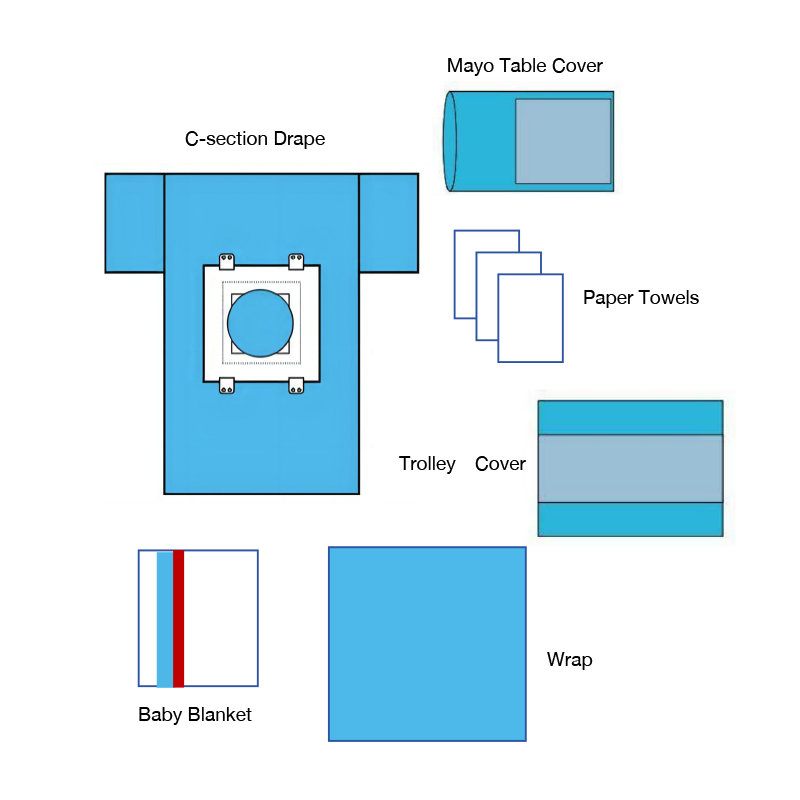 Custom Caesarean Section Surgical PackCustomizable caesarean pack with C-section drape, reinforced gowns, Mayo stand and back table covers, suture bag, and umbilical clamp; check the listed components.View Product →
Sterile drapes and gowns sold into Europe are typically assessed against EN 13795-1, which separates standard performance from high performance across barrier, strength, and linting. In the US market, gowns are commonly classified by AAMI PB70 levels 1 through 4, while drape critical zones are judged on resistance to liquid penetration. Ask for the test reports, not the marketing line: hydrostatic pressure, impact penetration, wet and dry tensile strength, and linting.
Most disposable obstetric packs are ethylene oxide sterilized under ISO 11135, with residuals limits and a validated shelf life — commonly three to five years, but only if the sterile barrier validation actually supports that figure. Confirm the barrier system, the aging study date, and the label language your market requires before the artwork is signed off.
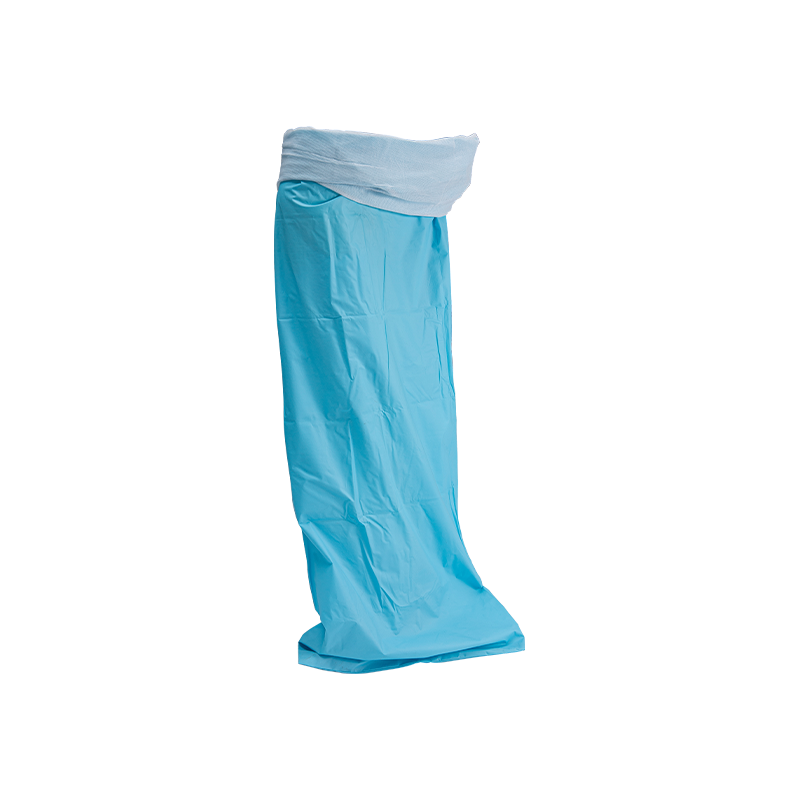 Custom TPE Stockinette for Surgical Pack AccessoriesCustomizable polyester-TPE stockinette in multiple sizes, intended to protect skin, absorb fluids, and distribute pressure; review sizes and request a quote.View Product →
Standards and Materials That Decide the Specification
Sterile drapes and gowns sold into Europe are typically assessed against EN 13795-1, which separates standard performance from high performance across barrier, strength, and linting. In the US market, gowns are commonly classified by AAMI PB70 levels 1 through 4, while drape critical zones are judged on resistance to liquid penetration. Ask for the test reports, not the marketing line: hydrostatic pressure, impact penetration, wet and dry tensile strength, and linting.
Materials you will see quoted
Sterility and shelf life
Most disposable obstetric packs are ethylene oxide sterilized under ISO 11135, with residuals limits and a validated shelf life — commonly three to five years, but only if the sterile barrier validation actually supports that figure. Confirm the barrier system, the aging study date, and the label language your market requires before the artwork is signed off.
Telling a Factory Apart From a Trading Company
Jiangsu Dingshun Medical Products Co., Ltd has produced disposable medical consumables since 2002 and supplies drapes and procedure packs to more than 33 countries, including North America, Europe, Japan and Korea.
Plenty of suppliers can quote a pack. Fewer knit the cuffs and stockinette that go inside it, control their own sewing lines, and can connect a yarn lot to a finished, sterilized kit. Vertical control is what keeps batch-to-batch variation small — and variation is exactly what surfaces as a drape that feels different in month fourteen.
Documentation is a fair proxy for process discipline. A factory that answers these in one email, with attachments, usually runs a stable line; one that answers with assurances usually does not. Our MDR certification progress is published for that reason — buyers should be able to check scope rather than take it on trust.
Order Planning: Lead Time, MOQ, and Release Documents
Lead time on a sterile delivery pack is rarely driven by sewing. It is component consolidation, sterilization cycle scheduling, and release testing. For a first order, plan 30 to 45 days from artwork approval; allow longer if a custom drape needs new tooling or a fresh sterile barrier validation.
Lock these before the purchase order is issued:
Procurement Risks Worth Watching
The expensive mistakes in this category are rarely dramatic. They accumulate quietly:
None of this demands a large quality department. It demands a written pack list, three or four test reports, and a supplier willing to show batch records before the first order rather than after the first complaint. Start there, and the price conversation gets considerably easier — because you are no longer comparing quotes, you are comparing what actually arrives sterile on the shelf.
This article provides general industry-technical reference only. It does not constitute product specification. Actual product performance shall refer to respective test reports and product labeling.
With the increasing emphasis on infection control and personnel protection in medical environments, disposable medical scrub suits play an increasingl...
READ MOREWhy are material quality and barrier protection crucial in a disposable cardiovascular surgical drape pack? The efficacy of disposable cardiovascular ...
READ MOREThe Importance of Disposable Obstetrics Drapes Packs In modern delivery practices, the disposable obstetrics drapes pack has become a crucial tool for...
READ MOREThe Critical Role of Medical Gowns in Healthcare In the dynamic and often hazardous environment of a healthcare facility, medical gowns serve as a pri...
READ MORE
 This website is intended for regions outside of China.