
 English
 中文简体
 Español

Industry News
Home / News / Industry News / Custom Earloop Knitting: Specs, Yarn Choices, and a Mask Line Fit Guide


 By Admin
Content
A mask line producing 400 units a minute still stops for one component: the ear loop. A snapped elastane core, a band measuring half a millimeter wider than the feeder expects, or an unflagged splice jamming the tension arm will halt the run, and the cost is counted in idle operators rather than in the few cents the band is worth. Custom earloop knitting is therefore less a catalogue order than a specification negotiation. The decisions made at the knitting machine, not at the converting machine, decide whether a clinician can keep a mask on through a twelve-hour shift.
An earloop is a narrow knitted elastic band, typically 3 to 6 mm wide, built around a spandex core and delivered on rolls or spools to a mask converter. Standard bands come in a handful of widths and tensions. A custom earloop is knitted to numbers the buyer fixes in advance, and three of those numbers matter more than the rest: width tolerance, force at working extension, and recovery after repeated cycling.
Force at working extension is the specification buyers most often leave to the supplier. Two manufacturers can both ship something honestly described as "3 mm white earloop" and still produce very different pressure on the helix and behind the ear, because the same nominal width can be knitted at different densities and around different spandex deniers.
Recovery is the second. A band that permanently grows by 15 percent after fifty donnings starts to slide down the face, and the wearer touches the mask to reposition it, which is exactly the behaviour infection-control teams work to prevent. Everything else, including colour, put-up length and splice policy, is easier to adjust later because it does not change how the loop behaves on a face.
The table below is a workable agenda for the first technical conversation with a knitting supplier. It is not a standard; it is a set of starting points that should be tightened or loosened against the mask design the loop will be assembled onto.
| Parameter | Common working range | What it decides | How to verify |
|---|---|---|---|
| Width | 3.0 to 6.0 mm | Pressure on the ear; fit in the feeder guide | Measure at rest, ten pieces per lot |
| Thickness | 0.5 to 1.2 mm | Weld or stitch quality; how flat the loop sits | Micrometer at three points |
| Force at 100% extension | About 1.0 to 2.5 N | Comfort over a full shift | Tensile pull at fixed extension |
| Elongation at break | 200% and above | Head-size range the mask tolerates | Tensile test on a defined gauge length |
| Recovery | 90% or more after 50 cycles | Whether the mask keeps its position | Cyclic loading test |
| Spandex denier | Commonly 300D to 620D | Hold versus softness; material cost | Yarn records and incoming inspection |
| Colour and colourfastness | White, black, custom | Visual detection; dye transfer to skin | Crock and perspiration testing |
| Put-up and splices | Fixed length per roll | Unplanned line stops | Count flagged splices per roll |
Width, force and recovery should be frozen first because they interact. Narrow the band and the same yarn feels firmer; raise the denier and recovery improves while the cost per metre climbs. Changing one number after tooling is set means a new sampling round.
Most medical earloops are flat-knit bands around a covered spandex core. The cover yarn, usually nylon and sometimes polyester, protects the elastane through knitting and assembly and sets the surface feel against skin. Crocheted or round-knit variants exist for heavier elastic cords, but on mask lines the flat band remains the practical default because it lies flat and welds predictably.
Higher spandex denier gives a firmer hold and a shorter, stiffer loop; lower denier feels lighter but recovers more slowly after hours under tension. Paediatric and small-face masks usually need a lower-force band than the adult product a buyer started with, and that is a knitting change rather than an assembly change. Nylon covers resist abrasion well and weld readily; polyester covers tolerate humid storage somewhat better and are often chosen where rolls sit in tropical warehouses for months.
Density matters as much as denier. A tightly knitted band with a small stitch length holds its width better through the feeder but feels firmer, so buyers who prioritise a soft hand feel often accept a slightly looser structure and compensate with a lower-force core.
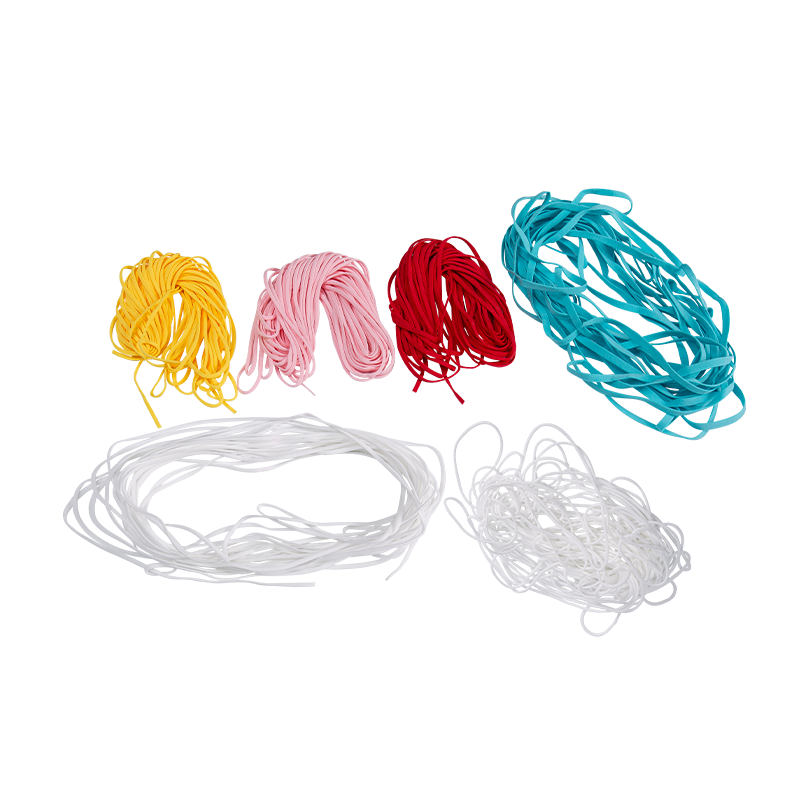 Polyester Spandex Earloop Knitting for Mask ComponentsKnitted earloop component available in multiple sizes and colors, suited to mask production where density, yarn, gauge and tension affect performance.View Product →
Earloops do not come off a dedicated mask machine. They are knitted on narrow-width machinery that also produces medical knitted cuffs, stockinette sleeve rolls and elastic bands used as surgical pack accessories. Manufacturers with that background, including Jiangsu Dingshun Medical Products Co., Ltd, which has knitted narrow medical components since 2002, tend to think in terms of yarn, needle gauge and tension rather than in terms of finished mask accessories.
That matters to buyers for two reasons. First, a supplier with knitting in-house can adjust gauge and density without changing subcontractors, which shortens sampling. Second, the same elastic that becomes an earloop on Monday may be specified as a cuff or a stockinette band on Tuesday, so the technical conversation stays comparable across several line items.
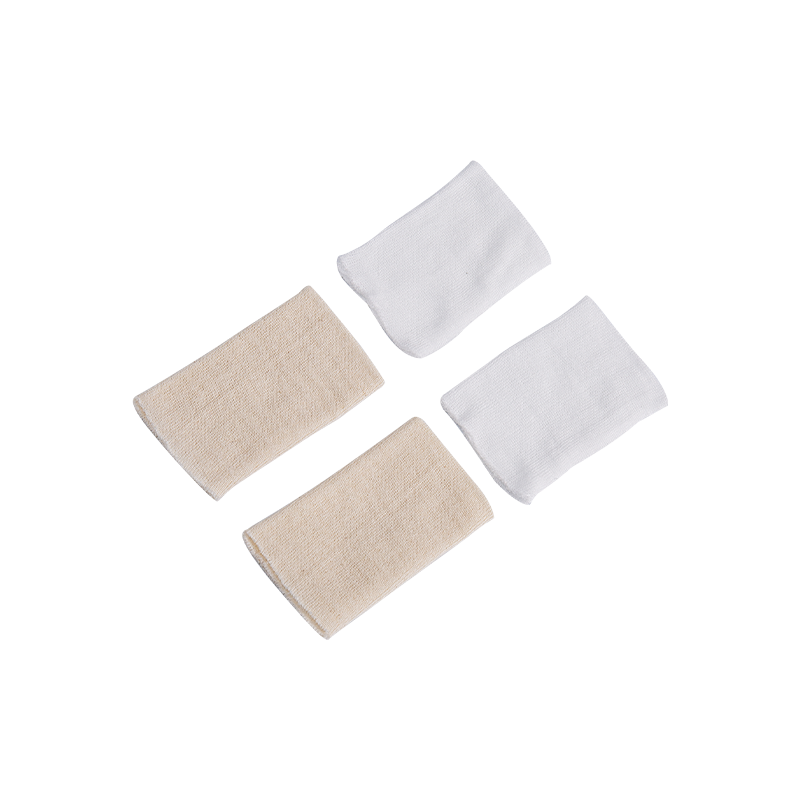 Medical Knitted Cuff for Surgical and Medical GownsCuff component for medical and surgical gowns, offered in cotton, cotton-polyester or polyester, with sizes from 1.6–15 inches and non-sterile raw or bleached white finishes.View Product →
Converters rarely reject a band on comfort grounds; they reject it because the feeder cannot handle it. Core diameter, roll weight, unwind tension, the direction of the wind and the position of splices all have to match the machine the roll will run on. A 500-metre roll that behaves on one mask line can drag on another with a lighter dancer arm.
Attachment method then narrows the choice further. Stitched loops tolerate a wide range of cover yarns and are common on reusable masks. Ultrasonically welded loops need a thermoplastic band that melts and bonds rather than a covered spandex core that resists heat, which is why TPE knits are specified where weld consistency matters more than the softest possible hand feel
Before committing to a full order, run three rolls on the actual production line and record stops per roll, splice frequency and rejection rate at the weld station. Two days of trial data usually settles questions that specification sheets cannot.Ear loops are cheap items with expensive failure modes, so the documentation behind the roll matters as much as the sample. A knitting supplier serving medical customers should be able to provide:
Regulatory status belongs in the same package. European buyers in particular ask for evidence of conformity before a band goes onto a mask carrying a CE mark, and a supplier's own certification path is a useful indicator of how seriously it treats documentation. MDR certification is one such signal when it covers the knitted product scope rather than only the finished pack.
Most earloop complaints trace back to a small number of repeatable problems, and all of them are visible in a properly designed trial:
Ask for the sampling calendar in writing as well: yarn lead time, first sample, validation batch and production date. Custom earloop knitting typically adds two to four weeks at the sampling stage, and buyers who plan for that avoid air-freighting a substitute band that later fails the weld test.
A custom earloop is a two-gram component with an outsized influence on whether a mask programme works. Fix width, force and recovery before anything else; confirm the put-up suits the machine; then insist on lot traceability and change control so the second order behaves like the first. Suppliers approached with those three items in hand tend to answer in engineering terms rather than in sales terms, which is the quickest way to tell which factories actually knit their own elastic.
With the increasing emphasis on infection control and personnel protection in medical environments, disposable medical scrub suits play an increasingl...
READ MOREWhy are material quality and barrier protection crucial in a disposable cardiovascular surgical drape pack? The efficacy of disposable cardiovascular ...
READ MOREThe Importance of Disposable Obstetrics Drapes Packs In modern delivery practices, the disposable obstetrics drapes pack has become a crucial tool for...
READ MOREThe Critical Role of Medical Gowns in Healthcare In the dynamic and often hazardous environment of a healthcare facility, medical gowns serve as a pri...
READ MORE
 This website is intended for regions outside of China.