
 English
  中文简体
中文简体  Español
Industry News
With the increasing emphasis on infection control and personnel protection in medical environments, disposable medical scrub suits play an increasingl...
READ MORE

 By Admin
Content
Reusable Surgical Gowns are designed to become part of a controlled healthcare workflow in which the same garment can be used multiple times after appropriate cleaning, inspection, and reprocessing. Unlike single-use garments that leave the workflow after one use, reusable gowns require coordinated management from initial distribution and wearing through collection, laundering, inspection, storage, and return to service.
In healthcare environments, gown selection should be based on the expected exposure, required barrier performance, garment design, durability, comfort, and practical handling requirements. The CDC recommends considering barrier properties together with garment design, integrity, durability, comfort, and functionality when selecting protective clothing.
Reusable gowns can be incorporated into different clinical workflows, including patient care, isolation procedures, laboratory activities, and surgical environments, provided that the gown construction and performance are appropriate for the intended application.
The primary operational difference is that a reusable gown creates an additional processing loop. After use, the garment is not simply discarded. It must be handled as contaminated or potentially contaminated textile material, transported through the appropriate reprocessing system, inspected, and returned to service only when its condition meets the established requirements.
|
Workflow Stage |
Key Activity |
Primary Objective |
|
Preparation |
Issue the appropriate size and gown configuration |
Ensure adequate coverage and correct fit |
|
Use |
Wear according to the intended clinical procedure |
Provide appropriate protection during patient interaction |
|
Removal |
Remove using the established procedure |
Reduce contamination of skin and clothing |
|
Collection |
Place used gowns into the designated textile stream |
Separate used garments from clean inventory |
|
Reprocessing |
Clean and process according to validated procedures |
Return the garment to a hygienically suitable condition |
|
Inspection |
Check fabric, seams, cuffs, closures, and dimensions |
Remove damaged or unsuitable garments |
|
Storage |
Store processed garments in a protected clean area |
Maintain cleanliness until the next use |
The main distinction is not simply the fabric or appearance, but the intended lifecycle. Reusable gowns are designed to withstand repeated processing, whereas single-use gowns are intended to provide protection during one use and then be discarded according to applicable procedures.
|
Factor |
Reusable Surgical Gowns |
Single-Use Medical Gowns |
|
Use cycle |
Multiple use cycles |
One intended use |
|
Post-use handling |
Collection and reprocessing required |
Disposal according to applicable procedures |
|
Material requirement |
Must tolerate repeated processing |
Primarily designed for the intended use period |
|
Inspection requirement |
Required throughout the service life |
Primarily focused on pre-use and in-use condition |
|
Inventory model |
Requires clean, used, and processing-cycle management |
Requires sufficient packaged inventory for ongoing demand |
|
Lifecycle consideration |
Performance must be considered over repeated processing |
Performance is primarily evaluated for the intended use cycle |
Reusable gowns have historically been manufactured from woven materials such as cotton, polyester, and cotton-polyester blends. The exact material construction can vary considerably, and the suitability of a particular fabric depends on the required barrier, strength, comfort, and processing performance.
In patient care environments, the gown should be selected according to the anticipated contact with blood, body fluids, or other potentially infectious materials. The CDC notes that gown selection should reflect the nature of the patient interaction and the expected degree of exposure.
For example, a facility may establish different gown configurations for routine patient care, contact precautions, procedures involving fluid exposure, and surgical activities. This approach avoids treating every clinical situation as having identical protection requirements.
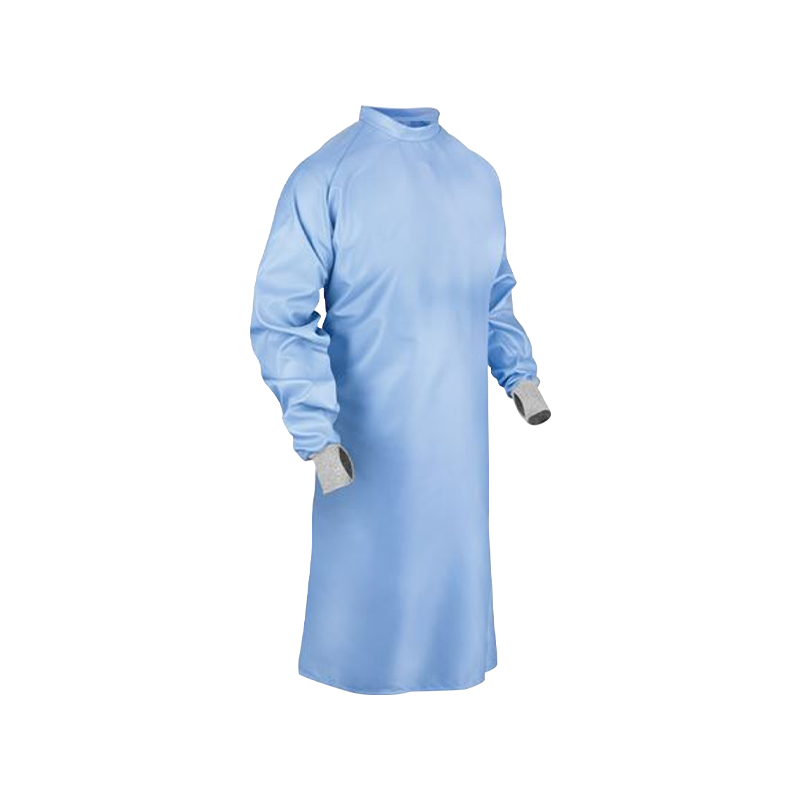
A reusable medical gown must provide sufficient coverage while allowing the wearer to perform normal clinical movements. Incorrect sizing can reduce coverage or create unnecessary restrictions, so healthcare facilities should maintain an appropriate range of sizes for their workforce.
Important areas include the front torso, shoulders, sleeves, wrists, and back overlap. The CDC specifically recommends sufficient fabric overlap to maintain back coverage when the wearer sits or squats.
|
Design Area |
Workflow Requirement |
Potential Issue if Inadequate |
|
Front coverage |
Protect exposed clothing and upper body areas |
Insufficient protection during patient contact |
|
Sleeves |
Provide arm coverage while allowing movement |
Restricted movement or exposed areas |
|
Cuffs |
Maintain stable wrist coverage |
Sleeve movement or poor glove interface |
|
Back overlap |
Maintain coverage during sitting and bending |
Exposed clothing or skin |
|
Closures |
Keep the gown securely positioned |
Opening or shifting during use |
The defining feature of a reusable gown workflow is the controlled reprocessing loop. Used garments should move through designated collection and processing procedures rather than being mixed with clean textile inventory.
A typical workflow can be represented as:
Use → Removal → Collection → Sorting → Cleaning → Drying → Inspection → Packaging or Storage → Redistribution → Reuse
Each stage can influence the condition of the garment. Washing and drying may affect dimensions, fabric strength, surface treatment, seam integrity, and barrier properties over time. Consequently, reusable gowns should be managed according to their established processing instructions and validated lifecycle requirements.
Healthcare infection-control guidance also emphasizes keeping clean textiles protected from dust and soil during transport, storage, loading, and unloading.
A reusable gown program requires coordination between clinical departments, infection-control personnel, laundry or reprocessing operations, and inventory management. The goal is to maintain a continuous supply of clean garments without compromising garment condition or workflow efficiency.
For reusable protective equipment, the CDC recommends that reusable items be maintained in good condition, cleaned before use, and reprocessed according to applicable instructions.
Reusable Surgical Gowns should be evaluated as part of a complete lifecycle rather than as isolated garments. The initial purchase quantity, number of processing cycles, turnaround time, inspection rate, repair requirements, replacement rate, and storage capacity can all influence the practical effectiveness of a reusable gown program.
|
Lifecycle Factor |
Operational Question |
Why It Matters |
|
Processing capacity |
Can the facility process the required number of used gowns? |
Determines turnaround capability |
|
Inventory size |
Are enough clean gowns available while others are being processed? |
Prevents shortages |
|
Inspection rate |
How consistently are garments checked before reuse? |
Helps identify damaged garments |
|
Processing durability |
How well does the gown withstand repeated processing? |
Influences usable service life |
|
Storage capacity |
Can clean garments be stored appropriately? |
Protects processed garments before use |
Ultimately, the value of Reusable Surgical Gowns depends on how effectively the garment design and reprocessing system work together. A suitable gown needs appropriate protection and comfort during use, while the healthcare organization needs a controlled system for collection, processing, inspection, storage, and redistribution. This lifecycle approach helps maintain consistent garment availability and supports reliable protective performance throughout repeated use.
The material and construction of a reusable medical gown must be designed for two requirements at the same time: protection during clinical use and stability throughout repeated processing. Unlike garments intended for a single use cycle, reusable gowns are exposed repeatedly to washing, drying, handling, folding, and, where applicable, sterilization. These processes can gradually influence fabric strength, dimensions, surface properties, seams, and barrier performance. Research has shown that laundering can affect the barrier characteristics of reusable surgical gown fabrics, making lifecycle performance an important part of material evaluation.
Reusable Surgical Gowns are commonly produced from woven textile structures using materials such as polyester, cotton, or polyester-cotton blends. Tightly constructed woven fabrics can provide a combination of mechanical durability, dimensional stability, and controlled liquid resistance. Some designs may also incorporate additional layers or membrane structures when a higher level of liquid protection is required.
Fiber selection should be based on the intended use and processing conditions rather than on fiber type alone. Polyester can provide good dimensional stability and resistance to repeated mechanical processing, while cotton can offer a different balance of moisture management and hand feel. Blended constructions can be engineered to combine selected characteristics of both fibers.
|
Material Approach |
Potential Characteristics |
Key Consideration for Reuse |
|
Polyester-based woven fabric |
Good dimensional stability and mechanical durability |
Evaluate thermal comfort and moisture management |
|
Cotton-based woven fabric |
Soft hand feel and moisture absorption |
Monitor dimensional change and repeated-processing effects |
|
Polyester-cotton blend |
Balanced mechanical and comfort characteristics |
Control shrinkage and maintain consistent fabric properties |
|
Multi-layer construction |
Can increase liquid barrier performance |
Evaluate flexibility, breathability, and layer durability |
|
Membrane-based construction |
Can provide enhanced liquid resistance |
Verify membrane integrity after repeated processing |
Fabric weight and thickness influence the physical behavior of a reusable gown, but they should not be treated as direct substitutes for barrier testing. A thicker fabric may provide greater resistance to liquid penetration in some constructions, but greater thickness can also increase garment weight and reduce flexibility or thermal comfort.
A comparative study of Reusable Surgical Gowns evaluated fabric weight and thickness alongside water resistance, strength, air permeability, dimensional stability, and other properties over repeated industrial laundering. The findings demonstrate why a single material parameter should not be used to judge overall gown performance.
|
Design Direction |
Potential Benefit |
Potential Trade-Off |
|
Higher fabric weight |
May improve mechanical robustness |
Can increase garment weight and thermal load |
|
Greater thickness |
May contribute to liquid resistance |
Can reduce flexibility and air permeability |
|
Lighter construction |
Lower weight and potentially better mobility |
May require optimized structure to maintain barrier performance |
|
Multi-layer construction |
Can combine different functional properties |
Additional interfaces must remain stable during repeated processing |
Liquid resistance is influenced by fabric structure, pore characteristics, surface repellency, thickness, and garment construction. Surface treatments can improve liquid repellency, but the treatment must remain sufficiently stable throughout the intended processing lifecycle.
Previous research on reusable surgical gown fabrics found that laundering could reduce the ability of some fabrics to prevent bacterial transmission, while fabrics with stronger retained repellency and certain reinforced constructions maintained better barrier performance.
For this reason, manufacturers should evaluate barrier performance both before and after representative laundering cycles. A new-garment test alone cannot establish how a reusable gown will perform throughout its service life.
Seams are structural and protective components of a reusable gown. They must withstand repeated flexing, washing, drying, and mechanical handling while maintaining the intended connection between fabric sections.
Common construction approaches include sewn seams, bound seams, taped seams, and welded or bonded structures, depending on the materials and performance requirements. The appropriate method should be selected according to fabric construction, barrier requirements, mechanical loads, and processing conditions.
|
Seam Construction |
Typical Function |
Important Lifecycle Consideration |
|
Sewn seam |
Mechanical joining of fabric panels |
Thread and stitch integrity after repeated processing |
|
Bound seam |
Controls fabric edges and reinforces construction |
Binding attachment and dimensional stability |
|
Taped seam |
Can improve barrier continuity at selected seams |
Adhesion and tape integrity during laundering |
|
Welded or bonded seam |
Creates a continuous material connection |
Resistance to heat, chemicals, and mechanical processing |
CDC guidance identifies fabric strength, seam strength, seam barrier properties, closures, garment size, and overall construction as important factors when selecting protective clothing.
The sleeve system requires particular attention because the lower sleeve and cuff contribute directly to wrist coverage and the interface with gloves. A reusable gown should maintain stable sleeve dimensions and cuff functionality after repeated processing.
Important construction variables include sleeve length, lower-sleeve circumference, cuff opening, cuff elasticity, and the method used to attach the cuff to the sleeve.
The sleeve and cuff should also be evaluated as part of the complete protective ensemble. CDC guidance emphasizes that interfaces between gowns and gloves are important because gaps or poorly integrated components can influence overall protection.
A reusable gown's closure system should maintain garment positioning without becoming a weak point during repeated use. Ties, fastening components, attachment points, and overlapping rear panels may be subjected to repeated pulling forces during donning and removal.
The rear construction should provide adequate coverage while allowing the wearer to bend, sit, reach, and move naturally. CDC guidance also highlights the importance of garment coverage, closures, and appropriate fit when evaluating protective clothing.
|
Construction Element |
Primary Function |
Repeated-Use Requirement |
|
Rear tie |
Secures the gown around the torso |
Maintain attachment strength after repeated use |
|
Closure attachment point |
Transfers fastening force to the garment |
Resist tearing and deformation |
|
Rear overlap |
Maintains body coverage |
Maintain dimensions after laundering |
|
Neck closure |
Stabilizes the upper garment |
Remain functional after repeated processing |
Dimensional stability is particularly important for reusable gowns because repeated laundering can change garment dimensions. Changes in sleeve length, torso dimensions, or cuff openings can alter fit and potentially affect the intended coverage.
A study evaluating Reusable Surgical Gowns after up to 75 industrial laundering cycles found measurable dimensional changes in some gown constructions, demonstrating the importance of monitoring shrinkage and other dimensional effects during lifecycle evaluation.
|
Dimension |
Why It Should Be Monitored |
|
Overall length |
Changes can affect lower-body coverage |
|
Sleeve length |
Changes can affect wrist and forearm coverage |
|
Torso width |
Changes can affect fit and movement |
|
Cuff opening |
Changes can affect wrist fit and glove compatibility |
|
Rear overlap |
Changes can affect back coverage |
A reusable gown should not be designed around durability alone. Medical personnel may wear the garment for extended periods, so flexibility, air permeability, moisture management, garment weight, and fabric hand can affect practical usability.
Research comparing reusable and disposable medical gowns evaluated air permeability and other comfort-related properties alongside strength and barrier performance. The study found that reusable gowns can have relatively low air permeability, illustrating the need to consider thermal comfort when selecting dense or highly protective constructions.
|
Design Priority |
Possible Advantage |
Possible Limitation |
|
High durability |
Supports repeated use |
May require stronger or denser material construction |
|
High barrier performance |
Improves resistance to liquid penetration |
May reduce air permeability |
|
High air permeability |
Can improve heat and moisture exchange |
Must remain compatible with required barrier performance |
|
Lightweight construction |
Can improve mobility and comfort |
May require additional structural engineering to maintain durability |
Repeated laundering exposes gowns to combinations of water, detergents or disinfectants, temperature, mechanical action, drying, and finishing processes. The exact processing conditions should follow validated procedures appropriate to the garment and its intended use.
Research on reusable medical textiles indicates that water temperature, cycle duration, mechanical action, disinfectant selection, and heat can all influence successful processing.
Consequently, reusable gown construction should be evaluated against the actual processing conditions rather than an assumed generic washing cycle.
For B2B procurement, material and construction should be evaluated using a lifecycle approach rather than assessing only the unused garment. A useful technical evaluation can include initial testing followed by representative processing intervals.
|
Evaluation Stage |
Key Parameters |
Purpose |
|
New garment |
Barrier performance, strength, dimensions, appearance |
Establish baseline performance |
|
Early processing stage |
Barrier retention, seam integrity, dimensional change |
Identify early degradation |
|
Mid-life evaluation |
Strength, cuff recovery, surface condition, barrier performance |
Monitor normal service performance |
|
End-of-life evaluation |
Barrier, tears, seams, dimensions, closures |
Establish replacement criteria |
The central principle is that reusable medical gown construction must remain functional throughout the intended service life. Fabric selection, surface treatment, sleeve and cuff design, seams, closures, and dimensional stability all contribute to lifecycle performance. A technically suitable reusable gown therefore requires more than a durable fabric; the complete garment must be engineered and evaluated as a system capable of maintaining protection, fit, comfort, and structural integrity through repeated processing.
The reprocessing workflow is a critical part of the reusable medical gown lifecycle because protection depends not only on the original garment design but also on how the gown is collected, cleaned, dried, inspected, stored, and returned to service. A properly organized workflow should prevent cross-contamination, protect the textile from unnecessary damage, and ensure that garments with holes, tears, weakened seams, or other defects are removed before reuse. Healthcare guidance emphasizes that reusable protective equipment should be maintained in good condition, cleaned before use, and reprocessed according to applicable instructions.
Reprocessing begins immediately after the gown is removed. Used gowns should enter a designated collection process rather than being mixed with clean garments. The objective is to contain contamination and minimize unnecessary handling.
Soiled textiles should not be shaken or handled in a way that could aerosolize infectious material. They should be placed into appropriate laundry bags or designated containers and transported according to the facility's established procedures.
The collection stage is important because poor handling before washing can create contamination risks even when the subsequent laundering process is properly controlled.
Sorting should occur before the washing cycle because not every reusable gown should automatically enter reprocessing. Garments should be assessed for visible contamination, damage, missing closures, excessive wear, and other conditions that could affect processing or subsequent use.
|
Inspection Item |
What to Check |
Action |
|
Fabric surface |
Holes, tears, thinning, excessive wear |
Repair or remove from service according to criteria |
|
Seams |
Loose stitching, opened seams, damaged bonding |
Repair or reject |
|
Cuffs |
Loss of elasticity, deformation, separation |
Repair or replace according to specification |
|
Closures |
Missing or damaged ties and fastening components |
Repair before reuse |
|
Surface contamination |
Blood, body fluids, chemicals, or other visible soil |
Process according to the applicable contaminated-textile procedure |
|
Identification |
Size, batch, tracking mark, or other identification |
Maintain traceability where applicable |
Reusable gown programs may use manual identification, barcodes, RFID systems, or other tracking methods to monitor garments through the processing cycle. Lifecycle tracking can help identify garments that have reached their defined service limits.
Washing is more than a simple rinse cycle; effective laundering depends on a combination of time, temperature, mechanical action, water quality, detergent chemistry, and the level of soiling. CDC guidance identifies these variables as important factors affecting laundering effectiveness.
The actual washing parameters should be established according to the garment's processing instructions, textile construction, facility equipment, and applicable infection-control requirements. A universal washing temperature or cycle should not be applied to every reusable medical gown.
|
Processing Variable |
Function |
Potential Effect if Poorly Controlled |
|
Water temperature |
Supports soil removal and microbial reduction |
Insufficient processing or excessive textile stress |
|
Cycle time |
Provides sufficient exposure to washing conditions |
Incomplete cleaning if insufficient |
|
Mechanical action |
Helps detach soil from the textile |
Poor soil removal or excessive fabric wear if improperly controlled |
|
Detergent chemistry |
Assists soil removal |
Reduced cleaning performance or material damage if unsuitable |
|
Water quality |
Influences detergent and washing performance |
Reduced process consistency |
|
Load volume |
Determines available washing action and chemical distribution |
Uneven or incomplete processing |
Current CDC recommendations for healthcare laundry include following fabric-care instructions and special laundering requirements, while specific hot-water parameters depend on the applicable healthcare laundry process.
After washing, the gown should be dried completely using a validated process compatible with its material and construction. Excessive heat or mechanical stress can contribute to dimensional changes, fabric degradation, seam damage, or deterioration of functional surface treatments.
Drying should therefore be treated as a controlled processing step rather than simply removing moisture. The drying method should be compatible with the fabric, coatings, laminates, elastic components, and other construction elements.
CDC guidance states that clean textiles should be completely dry before storage and that laundry equipment should be maintained according to manufacturer instructions.
Post-processing inspection is one of the most important control points in a reusable gown program. Washing can expose weaknesses that were not obvious during the initial inspection. A gown should not automatically return to service simply because it has completed a washing cycle.
|
Post-Processing Check |
Inspection Focus |
Reason |
|
Fabric integrity |
Holes, tears, thinning, abrasion |
Damage can reduce protective performance |
|
Seam condition |
Loose or separated seams |
Can affect structural and barrier integrity |
|
Cuff condition |
Elastic recovery and attachment |
Maintains wrist coverage |
|
Closures |
Ties, fasteners, and attachment points |
Maintains garment positioning |
|
Dimensions |
Length, width, sleeve dimensions, cuff opening |
Detects excessive shrinkage or deformation |
|
Surface condition |
Residual stains, chemical damage, coating deterioration |
Indicates potential processing problems |
Garments with small holes, tears, missing fastening components, or significant thinning should be repaired or removed from service according to the facility's defined criteria.
Not every reusable medical gown requires sterilization under every healthcare application. The required processing status depends on the intended use. Where sterility is required for patient care, the gown must undergo an appropriate sterilization process after laundering and preparation.
CDC guidance specifically states that sterilized textiles, surgical drapes, and gowns should be used for situations requiring sterility in patient care.
For gowns intended for sterilization, material selection and garment construction must be compatible with the validated sterilization process. Particular attention should be given to thermal stability, dimensional stability, seam integrity, closure components, packaging, and any coating or laminated structure.
After processing and inspection, clean gowns should be packaged or stored in a manner that prevents recontamination. Clean textile storage should be physically separated from soiled textile handling areas, with appropriate controls for dust, moisture, handling, and environmental contamination.
For sterile surgical applications, packaging becomes part of the sterile processing workflow and must maintain the required condition until use. For non-sterile applications, the objective remains to protect processed garments from contamination before distribution.
CDC recommendations emphasize packaging, transporting, and storing clean textiles in ways that protect them from dust and soil.
A reusable gown should be evaluated not only after the first wash but throughout its intended service life. Repeated exposure to washing, drying, mechanical action, chemicals, and sterilization can gradually alter the textile.
|
Lifecycle Parameter |
What to Monitor |
Possible Change Over Time |
|
Barrier performance |
Liquid resistance and penetration performance |
Reduction in protective performance |
|
Fabric strength |
Tensile and tear resistance |
Progressive weakening |
|
Seam integrity |
Stitching, bonding, and seam strength |
Loose or separated seams |
|
Dimensions |
Length, width, sleeve and cuff measurements |
Shrinkage or deformation |
|
Surface properties |
Repellency, coating, or laminate condition |
Loss of functional surface characteristics |
|
Closures |
Attachment and functionality |
Loosening or breakage |
Research on reusable surgical gown fabrics has demonstrated that laundering can affect barrier properties, including the ability of fabrics to prevent microbial transmission. This supports the need for lifecycle-oriented evaluation rather than relying only on the condition of a new gown.
There is no single processing cycle that is appropriate for every reusable medical gown. The correct parameters depend on the textile construction, contamination level, washing equipment, detergent system, drying method, sterilization requirements, and applicable healthcare procedures.
A practical validation program can evaluate the following variables:
|
Parameter |
Example Range or Condition |
Validation Purpose |
|
Wash temperature |
Defined by the validated laundering procedure |
Balance cleaning effectiveness and textile durability |
|
Wash duration |
Defined by the validated cycle |
Provide sufficient processing exposure |
|
Mechanical action |
Controlled by washer cycle and load conditions |
Support soil removal without excessive textile damage |
|
Detergent concentration |
Specified according to the validated process |
Achieve consistent cleaning performance |
|
Drying temperature |
Controlled according to fabric requirements |
Prevent excessive thermal degradation |
|
Processing cycles |
Defined by lifecycle validation |
Establish usable service life |
For example, CDC guidance includes a hot-water healthcare laundry recommendation of at least 71°C for at least 25 minutes in specified circumstances, while other laundry guidance describes 70–80°C for 10 minutes for particular reusable textile processing applications. These figures should not be treated as universal gown specifications; the applicable procedure must be determined from the garment instructions and healthcare facility requirements.
Once a gown has been washed, dried, inspected, and processed to the required standard, it can return to clean inventory. If defects are identified, the garment should be routed for repair, additional evaluation, or retirement rather than automatically redistributed.
An effective reusable medical gown workflow can therefore be summarized as:
Use → Safe Removal → Contained Collection → Sorting → Washing → Drying → Inspection → Sterilization When Required → Packaging/Storage → Redistribution → Reuse
The strength of a reusable gown program comes from controlling every stage of this loop. Material durability alone cannot compensate for poor collection, inappropriate laundering, inadequate inspection, or improper storage. Conversely, a well-controlled reprocessing system can help preserve garment performance and provide a more consistent supply of reusable protective apparel.
Reusable Surgical Gowns can be used across multiple healthcare environments when their barrier performance, garment construction, and reprocessing requirements are matched to the intended task. The appropriate application depends primarily on the expected contact with blood, body fluids, secretions, excretions, contaminated surfaces, and other potentially infectious materials. Healthcare guidance recommends selecting gowns according to the nature of the patient interaction and the anticipated degree of exposure rather than using one gown configuration for every situation.
Routine patient care is one of the common application areas for medical gowns. Reusable gowns can be incorporated into established textile and infection-control workflows when the garment provides suitable coverage and can be processed according to validated procedures.
For routine care, the primary objective is generally to protect exposed clothing and skin when contact with a patient, body fluids, secretions, excretions, or contaminated surfaces is anticipated. The CDC recommends selecting gowns according to the specific patient-care activity and expected exposure.
For these applications, coverage, fit, sleeve length, cuff design, and ease of movement are important. Several sizes should be available so that healthcare personnel can obtain adequate coverage without excessive garment material restricting movement.
Reusable Surgical Gowns can also be used within isolation workflows when their protective characteristics are appropriate for the anticipated exposure. Isolation gowns are intended to protect the arms and exposed body areas while helping prevent contamination of clothing during patient-care activities.
The required protection level should be determined by the specific clinical situation. A gown used for routine contact precautions does not necessarily require the same barrier characteristics as a gown used during a procedure involving substantial fluid exposure.
|
Application Condition |
Primary Selection Focus |
Important Gown Characteristics |
|
Routine patient contact |
Coverage and contamination control |
Appropriate length, sleeves, cuffs, fit |
|
Contact precautions |
Protection from contaminated surfaces and materials |
Full arm and front-body coverage |
|
Potential splash exposure |
Liquid barrier performance |
Appropriate fluid resistance and critical-zone coverage |
|
High fluid exposure |
Enhanced barrier protection |
Higher verified liquid barrier performance |
CDC guidance indicates that isolation gowns should provide full coverage of the arms and the front of the body, extending from the neck toward at least the mid-thigh or below.
Surgical applications require a more specific evaluation because surgical gowns are intended to protect both healthcare personnel and patients during procedures. The required construction and barrier performance depend on the surgical procedure, expected fluid exposure, and applicable regulatory and technical requirements.
For surgical gowns, critical protection zones include the front of the body from the shoulders toward the knees and the arms from the wrist cuff to above the elbow. The FDA recognizes ANSI/AAMI PB70 as the classification system for liquid barrier performance of protective apparel used in healthcare facilities.
|
Surgical Application Factor |
What Should Be Evaluated |
Reason |
|
Fluid exposure |
Required liquid barrier level |
Procedures can involve different levels of fluid exposure |
|
Critical zones |
Front and sleeve protection |
These areas require defined barrier performance |
|
Seams |
Mechanical and barrier integrity |
Seams can influence overall garment protection |
|
Cuffs |
Wrist coverage and glove interface |
Helps maintain continuous protection around the wrist |
|
Fit |
Mobility and coverage |
Supports normal surgical movement |
It is important to distinguish general Reusable Surgical Gowns from reusable surgical gowns. A reusable garment should not be used for a surgical application simply because it is washable. The garment must meet the performance, sterility, labeling, and processing requirements applicable to the intended surgical use.
Laboratories and diagnostic areas may involve contact with biological specimens, contaminated materials, chemicals, or laboratory equipment. The appropriate gown construction depends on the specific hazards present in the working environment.
Reusable Surgical Gowns used in laboratory environments should therefore be selected according to the exposure pathway rather than simply the laboratory name. Liquid penetration, chemical compatibility, sleeve coverage, cuff design, and ease of decontamination may all require evaluation.
For example, the FDA identifies Level 2 medical gown protection as appropriate for certain lower-risk activities such as blood draws, suturing, ICU activities, and pathology laboratory work, while higher levels are associated with increasing fluid exposure.
Emergency departments and trauma-related procedures can involve unpredictable movement, rapid treatment, and potentially significant exposure to blood and body fluids. In these circumstances, gown selection should focus on the actual risk rather than on the department designation alone.
For higher exposure conditions, liquid barrier performance becomes increasingly important. The FDA's recognized gown classification framework identifies Level 3 for moderate-risk applications such as arterial blood draws, IV insertion, emergency-room activities, and trauma cases, while Level 4 is associated with high-risk, fluid-intensive procedures and surgery.
|
Exposure Scenario |
Typical Risk Consideration |
Selection Priority |
|
Routine examination |
Limited anticipated fluid contact |
Coverage, comfort, mobility |
|
Blood-related procedure |
Potential liquid contact |
Liquid barrier performance |
|
Trauma care |
Potential moderate to high fluid exposure |
Enhanced barrier and critical-zone coverage |
|
Fluid-intensive procedure |
High liquid exposure |
High verified barrier performance and appropriate construction |
Some healthcare procedures create substantially greater opportunities for liquid contact than routine patient care. These situations require closer attention to the gown's liquid barrier properties, critical zones, seams, and interfaces.
Examples can include procedures involving substantial irrigation, blood loss, or other conditions where the gown may be exposed to significant amounts of liquid. The appropriate barrier level should be selected according to the expected exposure and the applicable classification requirements.
CDC research on protective clothing notes that resistance to blood and body-fluid penetration can vary according to material characteristics, impermeability, garment design, and wear and tear.
The suitability of a reusable gown depends not only on the clinical application but also on whether the healthcare facility can maintain an effective reprocessing system. Reusable gowns require collection, transportation, cleaning, inspection, storage, and inventory management. The facility therefore needs sufficient processing capacity and clean-garment availability.
Reusable gowns are typically made from polyester or polyester-cotton fabrics, according to CDC information on reusable isolation gowns.
|
Operational Factor |
Suitable Condition |
Potential Challenge |
|
Reprocessing capacity |
Reliable laundering and processing system |
Insufficient capacity can delay garment availability |
|
Inventory |
Enough garments to cover the processing cycle |
Insufficient stock can create shortages |
|
Inspection |
Defined post-processing inspection procedure |
Damaged garments may remain in circulation if controls are weak |
|
Storage |
Protected clean-textile storage |
Poor storage can compromise cleanliness |
|
Lifecycle tracking |
Defined service-life criteria |
Uncontrolled reuse can increase wear-related risks |
There is no universal reusable medical gown suitable for every healthcare task. The correct configuration should be determined through a risk-based assessment that considers the procedure, expected fluid exposure, required coverage, duration of use, and reprocessing capability.
|
Application |
Primary Requirement |
Key Design Considerations |
|
Routine patient care |
Basic contamination protection |
Coverage, fit, mobility, comfort |
|
Isolation care |
Protection from contact contamination |
Arm and front-body coverage, cuffs, closures |
|
Laboratory work |
Exposure-specific protection |
Liquid resistance, chemical compatibility where applicable |
|
Emergency and trauma care |
Protection against potentially higher fluid exposure |
Barrier performance, critical-zone coverage, mobility |
|
Surgical procedures |
Defined surgical barrier protection |
Critical zones, sterile presentation, seams, cuffs, closures |
|
Fluid-intensive procedures |
Enhanced liquid barrier |
Appropriate barrier classification and garment construction |
The most effective approach is to match the reusable medical gown to the actual exposure scenario instead of selecting the highest protection level for every task. Excessively protective constructions may add weight, reduce breathability, or restrict movement, while insufficient protection can leave the wearer inadequately protected.
For example, the FDA classification framework distinguishes minimal, low, moderate, and high-risk liquid exposure scenarios, demonstrating that gown selection should correspond to the level of anticipated exposure.
Reusable Surgical Gowns can therefore serve a wide range of healthcare applications, but their suitability depends on the complete combination of barrier performance, garment coverage, material durability, construction, wearer mobility, processing requirements, and application-specific risk. A well-designed reusable gown program should evaluate these factors together rather than treating reusability as the only selection criterion.
The economic value of Reusable Surgical Gowns should be evaluated across the complete service lifecycle rather than by comparing the initial garment price alone. For healthcare facilities, the practical cost of a reusable gown includes acquisition, cleaning, drying, inspection, repair, storage, inventory management, and eventual replacement. At the same time, operational efficiency depends on processing capacity, turnaround time, garment durability, and the availability of clean gowns when they are needed.
A reusable gown generally requires a higher initial investment in textile garments and supporting inventory than a system based entirely on single-use garments. However, the same garment can potentially complete multiple validated use and reprocessing cycles. This makes cost per use a more meaningful indicator for lifecycle analysis.
A simplified calculation can be expressed as:
Cost Per Use = (Initial Garment Cost + Cumulative Processing Cost + Repair Cost + Management Cost) ÷ Number of Validated Uses
The calculation should also consider garments removed from service before reaching their expected lifecycle. If a gown is discarded early because of fabric damage, dimensional changes, seam failure, or loss of required barrier performance, its actual cost per use will be higher than the theoretical value.
|
Cost Factor |
Reusable Gown |
Operational Impact |
|
Initial garment acquisition |
Higher upfront inventory investment |
Requires initial capital allocation |
|
Cleaning |
Recurring processing cost |
Depends on laundering volume and process |
|
Drying and finishing |
Recurring processing cost |
Influenced by equipment, energy, and cycle time |
|
Inspection |
Required throughout service life |
Requires labor and quality-control procedures |
|
Repair |
May be required during service life |
Can extend usable life when repair is appropriate |
|
Replacement |
Required when lifecycle criteria are reached |
Depends on durability and processing conditions |
Laundering is usually one of the most important recurring costs in a reusable gown program. Processing cost can include labor, water, detergents, disinfecting agents where applicable, electricity or other energy sources, equipment depreciation, maintenance, transportation, and facility overhead.
The actual cost varies significantly between healthcare facilities because processing capacity and operating conditions differ. A high-volume centralized laundry may achieve different economics from a smaller facility with limited equipment and longer transport distances.
|
Processing Variable |
Effect on Cost |
Efficiency Consideration |
|
Load size |
Influences cost per processed garment |
Optimize loading without exceeding equipment limits |
|
Wash cycle duration |
Affects equipment utilization |
Use validated cycles appropriate to the garment |
|
Water consumption |
Contributes to utility cost |
Control consumption while maintaining required processing performance |
|
Energy consumption |
Influences washing and drying costs |
Optimize validated thermal and drying processes |
|
Labor |
Includes sorting, loading, inspection, folding, and handling |
Efficient workflow reduces unnecessary handling |
|
Transportation |
Applies when garments move between facilities |
Shorter and better-organized textile routes can improve efficiency |
Durability directly affects the economics of a reusable gown because a longer usable service life distributes the initial garment cost across more use cycles. However, the number of times a gown can be reused should not be assumed from a theoretical washing count. The actual service limit should be based on validated performance and inspection criteria.
Repeated laundering can affect fabric strength, dimensions, surface properties, seams, cuffs, and liquid barrier performance. Therefore, lifecycle testing should evaluate whether the garment continues to meet its intended requirements after representative processing cycles.
|
Lifecycle Condition |
Potential Cost Effect |
Management Response |
|
Stable performance over many cycles |
Lower cost per use |
Continue use within validated limits |
|
Minor repairable damage |
Additional maintenance cost |
Repair when technically appropriate |
|
Frequent early damage |
Higher replacement cost |
Investigate material, processing, or handling conditions |
|
Loss of required barrier performance |
Premature retirement |
Remove from the applicable protective-use cycle |
|
Significant dimensional change |
Reduced usability |
Inspect against established dimensional criteria |
A reusable gown system needs sufficient inventory to cover garments that are currently being worn, collected, processed, inspected, stored, or transported. The total inventory requirement is therefore normally greater than the number of gowns being used at one moment.
A basic inventory model can be divided into several groups:
If processing takes longer than expected, more garments may need to remain in circulation to prevent shortages. For this reason, turnaround time is an important operational parameter alongside garment durability.
Repair can extend the service life of a reusable gown when the damage is localized and the repaired garment continues to meet the applicable requirements. Typical repairable problems may include certain damaged ties, localized stitching defects, or other minor structural issues, depending on the garment's specifications.
Replacement is more appropriate when damage affects critical barrier areas, when fabric degradation is extensive, or when the garment can no longer meet the required performance criteria.
|
Condition |
Potential Action |
Economic Consideration |
|
Minor closure damage |
Repair if permitted |
May cost less than replacing the complete gown |
|
Localized seam defect |
Inspect and repair when appropriate |
Can extend service life |
|
Small non-critical fabric damage |
Evaluate according to defined criteria |
Repair may be possible depending on construction |
|
Large tear or extensive thinning |
Remove from service |
Replacement is generally more appropriate |
|
Loss of required barrier performance |
Remove from applicable protective use |
Safety and performance take priority over continued use |
The labor requirement of a reusable gown program extends beyond washing. Personnel may be required for collection, sorting, machine loading, unloading, inspection, folding, packaging, inventory recording, repairs, and distribution.
Operational efficiency can improve when these activities are standardized. Clearly defined textile routes and inspection criteria can reduce unnecessary handling and make it easier to identify garments that should be repaired or retired.
When comparing reusable and single-use gown systems, the analysis should include more than acquisition price. A meaningful comparison considers the complete operating model.
|
Evaluation Factor |
Reusable System |
Single-Use System |
|
Initial garment investment |
Higher inventory investment may be required |
Lower reusable inventory requirement |
|
Post-use processing |
Cleaning and inspection required |
Disposal process required |
|
Use cycles per garment |
Multiple cycles within validated limits |
One intended use cycle |
|
Processing infrastructure |
Required |
Generally not required for the garment itself |
|
Inventory management |
Must account for garments in processing |
Primarily manages unused packaged inventory |
|
Repair management |
Potentially required |
Generally not applicable |
|
Lifecycle tracking |
Useful for controlling service life |
Usually focused on stock and expiration where applicable |
This comparison does not establish that one system is economically superior in every facility. The result depends on local labor costs, laundering capacity, garment durability, clinical demand, transportation requirements, waste-management costs, and the number of validated use cycles.
A simplified example illustrates why lifecycle analysis is important. Suppose a reusable gown has an acquisition cost of $40, accumulates $60 in processing and maintenance costs during its validated service life, and completes 50 valid use cycles.
Total lifecycle cost = $40 + $60 = $100
Cost per use = $100 ÷ 50 = $2.00 per use
This calculation is only an illustrative model. Actual procurement analysis should replace these values with facility-specific acquisition, processing, labor, repair, transportation, and replacement data.
Several management practices can help improve the performance of a reusable gown program without compromising the required protective function:
Lower cost is not a sufficient reason to extend the use of a reusable medical gown beyond its validated service condition. If a garment no longer provides the required barrier performance, structural integrity, coverage, or fit, continued use can undermine the purpose of the protective garment.
The most useful lifecycle model therefore combines economic and technical indicators:
|
Indicator |
Purpose |
|
Cost per use |
Measures economic efficiency over the garment lifecycle |
|
Number of valid processing cycles |
Measures practical service life |
|
Repair frequency |
Identifies durability and maintenance requirements |
|
Retirement rate |
Shows how quickly garments leave circulation |
|
Processing turnaround time |
Measures operational efficiency |
|
Garment availability |
Indicates whether inventory supports clinical demand |
|
Barrier performance retention |
Confirms continued protective suitability |
A well-managed reusable medical gown program should therefore balance acquisition cost, processing cost, service life, inventory requirements, and protective performance. The most meaningful economic assessment is not simply how much a gown costs to purchase, but how reliably it performs throughout its validated lifecycle and how efficiently the healthcare organization can collect, reprocess, inspect, store, and redistribute it.
Selecting a reusable medical gown requires more than evaluating fabric quality or purchase price. Healthcare facilities should consider the expected exposure, required barrier performance, garment coverage, durability, reprocessing conditions, fit, comfort, and lifecycle performance together. For reusable gowns, the evaluation should also confirm that the garment continues to meet its stated requirements after the maximum labeled number of reprocessing cycles.
The first selection criterion is the level of liquid exposure expected during use. Different clinical activities create different risks, so a single protection level should not be applied to every application.
ANSI/AAMI PB70 provides a classification framework for protective apparel based on liquid barrier performance. The four levels range from Level 1 for minimal-risk situations to Level 4 for high-risk applications.
|
Barrier Level |
General Exposure |
Typical Application Examples |
|
Level 1 |
Minimal risk |
Basic care and standard isolation situations |
|
Level 2 |
Low risk |
Blood draws, suturing, ICU activities, pathology laboratory work |
|
Level 3 |
Moderate risk |
Arterial blood draws, IV procedures, emergency and trauma care |
|
Level 4 |
High risk |
Fluid-intensive procedures and surgical applications |
These levels should be treated as classification references rather than a simple ranking where the highest level is automatically preferable. CDC guidance recommends identifying the hazard and expected exposure first, then selecting protective clothing based on the required barrier properties.
Barrier performance depends on garment construction as well as fabric performance. A material with suitable laboratory results cannot provide equivalent protection if important areas of the finished gown are inadequately covered.
For surgical gowns, critical areas generally include the front of the gown and specified portions of the sleeves. For isolation gowns, the critical area is substantially broader because exposure can occur across the garment.
CDC guidance specifically notes that seams and closures are critical components of overall barrier protection and should be evaluated in addition to the fabric itself.
Reusable gowns are repeatedly exposed to washing, drying, handling, folding, and potentially sterilization. Consequently, durability is a fundamental selection criterion.
|
Property |
What to Evaluate |
Why It Matters |
|
Fabric tensile strength |
Resistance to stretching and mechanical loading |
Helps prevent tearing during use |
|
Tear resistance |
Ability to resist propagation of fabric damage |
Important during bending, reaching, and handling |
|
Seam strength |
Resistance of joined fabric panels to separation |
Supports structural integrity |
|
Dimensional stability |
Changes in length and width after processing |
Helps maintain consistent fit and coverage |
|
Surface durability |
Retention of coatings or repellency where applicable |
Supports consistent barrier performance |
CDC selection guidance identifies fabric strength, seam strength, barrier properties of seams and closures, garment size, durability, and comfort as relevant factors when evaluating protective clothing.
A reusable gown should be selected together with its intended reprocessing method. Washing temperature, detergent chemistry, mechanical action, drying conditions, and sterilization requirements can all influence garment performance over time.
The processing instructions should clearly define the conditions under which the garment can be safely and effectively reprocessed. If a gown is intended for repeated use, its performance should be evaluated through the labeled maximum reprocessing cycles rather than only when new. FDA guidance specifically identifies end-of-use-life testing for reusable gowns as part of barrier-performance evaluation.
|
Reprocessing Factor |
Selection Question |
Potential Impact |
|
Wash temperature |
Is the material compatible with the validated temperature? |
Excessive heat may accelerate material degradation |
|
Detergent chemistry |
Is the textile compatible with the specified chemicals? |
Unsuitable chemistry may affect fabric or surface treatments |
|
Mechanical action |
Can the garment withstand repeated washing action? |
Excessive mechanical stress may increase wear |
|
Drying |
Can the garment tolerate the specified drying process? |
Improper thermal exposure may cause shrinkage or degradation |
|
Sterilization |
Is sterilization required and is the gown compatible with the process? |
Thermal or chemical exposure may affect construction |
For Reusable Surgical Gowns, the number of processing cycles should be supported by testing rather than treated as an arbitrary reuse number. A gown may look acceptable after repeated laundering while certain performance characteristics have already changed.
Lifecycle evaluation should include barrier performance, fabric strength, seam integrity, dimensions, closures, cuffs, and other relevant properties. FDA guidance specifically states that reusable gowns should undergo barrier-performance testing at the end of the labeled use-life or maximum reprocessing cycles.
|
Lifecycle Stage |
Recommended Evaluation Focus |
|
New gown |
Establish baseline performance |
|
Early reprocessing |
Identify initial dimensional or structural changes |
|
Mid-life |
Monitor barrier, strength, seams, cuffs, and closures |
|
Maximum labeled cycles |
Confirm continued compliance with required performance |
|
Beyond validated life |
Do not assume continued protective performance without supporting evaluation |
Proper fit is directly related to both protection and usability. A gown that is too small may restrict movement or leave areas insufficiently covered, while an excessively large gown can interfere with movement and increase the possibility of snagging.
Important dimensions include overall length, chest or torso width, sleeve length, cuff opening, and closure positioning.
CDC guidance recommends considering garment size and availability of an appropriate size range because fit can influence both protection and practical use.
Increasing barrier performance does not automatically improve the suitability of a gown for every application. Heavier or denser materials can affect breathability, thermal comfort, flexibility, and wearer fatigue.
|
Design Priority |
Potential Benefit |
Potential Trade-Off |
|
Higher barrier performance |
Greater resistance to liquid exposure |
May reduce breathability or flexibility |
|
Lower garment weight |
Improved mobility and comfort |
May require careful material engineering to maintain protection |
|
Higher fabric density |
Can contribute to barrier performance |
May increase thermal load |
|
Higher air permeability |
Can improve heat and moisture exchange |
Must remain compatible with required barrier performance |
CDC recommends considering comfort, breathability, air permeability, ergonomics, and integration with other PPE in addition to barrier performance.
A reusable medical gown should not be evaluated as an isolated garment. Its interaction with gloves, masks, eye protection, respirators, and other protective equipment can influence the effectiveness of the complete PPE ensemble.
Particular attention should be paid to the interfaces between the gown cuff and gloves and between the collar or upper garment and other protective equipment. CDC guidance identifies these interfaces as important factors in overall PPE protection.
Technical documentation should provide enough information for procurement and clinical teams to determine whether the gown is appropriate for its intended application.
|
Document or Data |
Why It Is Important |
|
Barrier classification |
Shows the stated level of liquid barrier performance |
|
Test results |
Provides objective performance evidence |
|
Material specification |
Helps evaluate construction and processing compatibility |
|
Garment dimensions |
Supports correct sizing and coverage assessment |
|
Reprocessing instructions |
Defines applicable cleaning and processing conditions |
|
Maximum use life |
Defines the validated reuse limit |
|
Inspection criteria |
Helps determine when garments should be repaired or removed |
FDA guidance recommends documentation covering barrier protection levels, critical and non-critical zones, dimensions, directions for use, and other relevant information.
For Reusable Surgical Gowns, procurement decisions should consider the complete lifecycle cost. The relevant factors include initial acquisition, laundering, drying, inspection, repair, transportation, inventory, and replacement.
A basic calculation is:
Lifecycle Cost Per Use = Total Garment and Processing Cost ÷ Validated Number of Uses
The calculation should be based on actual facility conditions. A garment with a low acquisition price may not provide the lowest lifecycle cost if it requires frequent replacement or generates high processing costs.
A structured evaluation can make procurement decisions more consistent and easier to document.
|
Selection Category |
Key Question |
Priority |
|
Clinical exposure |
What type and level of fluid exposure is expected? |
Critical |
|
Barrier performance |
Does the garment meet the required classification? |
Critical |
|
Coverage |
Are critical areas adequately protected? |
Critical |
|
Durability |
Can the garment withstand repeated processing? |
High |
|
Reprocessing |
Can existing facilities process the gown correctly? |
High |
|
Fit |
Are appropriate sizes available? |
High |
|
Comfort |
Can personnel perform required tasks comfortably? |
Medium to High |
|
PPE compatibility |
Does the gown integrate correctly with gloves and other PPE? |
High |
|
Lifecycle cost |
Is the total cost per validated use acceptable? |
Medium to High |
The most reliable selection process combines exposure assessment, barrier classification, garment construction, durability, reprocessing compatibility, fit, comfort, PPE integration, documentation, and lifecycle economics. Reusability alone does not determine whether a gown is suitable. The garment must continue to provide the required protection throughout its validated service life while remaining practical for the healthcare facility's processing and inventory system.
Effective maintenance and quality control are essential for keeping Reusable Surgical Gowns safe, functional, and suitable for continued use. Unlike single-use garments, reusable gowns pass through multiple cycles of wearing, collection, laundering, drying, inspection, and storage. Each cycle can gradually affect fabric strength, seams, closures, dimensions, and barrier performance. A structured quality-control program should therefore evaluate the gown throughout its service life rather than only when it is new.
Every reusable gown should be inspected after reprocessing before it returns to clean inventory. Visual inspection can identify obvious defects, while periodic technical testing can be used to verify performance characteristics that cannot be determined through visual examination alone.
|
Inspection Area |
Items to Check |
Possible Defect |
|
Fabric |
Holes, tears, thinning, abrasion |
Reduced structural or barrier performance |
|
Seams |
Loose stitching, separation, damaged bonding |
Loss of garment integrity |
|
Cuffs |
Elasticity, attachment, deformation |
Poor wrist coverage or glove interface |
|
Closures |
Ties, fasteners, attachment points |
Insecure garment positioning |
|
Dimensions |
Length, width, sleeve length, cuff opening |
Shrinkage or deformation |
|
Surface |
Staining, coating damage, unusual wear |
Possible processing or material degradation |
Any gown showing damage that could affect its intended protective function should be removed from the applicable service cycle until it has been evaluated. CDC guidance recommends considering fabric strength, seam strength, barrier properties, garment size, durability, and functionality when selecting and evaluating protective clothing.
Repeated processing can gradually change the physical and functional characteristics of textile garments. Quality control should therefore compare performance at different stages of the validated service life.
|
Performance Parameter |
Initial Evaluation |
Periodic Evaluation |
End-of-Life Evaluation |
|
Barrier performance |
Establish baseline |
Monitor retention |
Confirm required performance |
|
Fabric strength |
Establish baseline |
Check degradation |
Confirm structural suitability |
|
Seam integrity |
Verify construction |
Monitor wear |
Check for failure or separation |
|
Dimensions |
Record garment measurements |
Monitor shrinkage |
Confirm acceptable dimensional range |
|
Closures and cuffs |
Verify functionality |
Monitor wear |
Confirm continued functionality |
For reusable gowns, FDA guidance indicates that barrier-performance testing should also be performed at the end of the labeled use life or maximum reprocessing cycles.
Quality control should include the laundering process itself because inappropriate processing conditions can shorten garment life or affect protective performance. The process should be defined according to the gown construction and validated instructions rather than using uncontrolled washing parameters.
FDA identifies reprocessing methodology, device design, and validation of cleaning and disinfection or sterilization instructions as factors that can affect the quality of reprocessing.
A reusable gown should have clearly defined criteria for repair, continued use, and retirement. Without consistent criteria, individual inspectors may make different decisions about the same garment, reducing the reliability of the quality-control system.
|
Condition |
Recommended Evaluation |
Possible Decision |
|
Minor closure defect |
Check whether structural and protective requirements remain unaffected |
Repair if permitted |
|
Localized seam defect |
Evaluate seam integrity and location |
Repair or remove from service |
|
Small fabric defect |
Assess location and effect on protection |
Repair or retire according to defined criteria |
|
Extensive tearing or thinning |
Assess overall garment integrity |
Retire |
|
Loss of required barrier performance |
Confirm through applicable testing or evaluation |
Remove from the intended protective application |
|
Excessive dimensional change |
Compare against specified dimensions |
Retire if coverage or fit is compromised |
Tracking the processing history of reusable gowns can improve quality control by connecting garment condition with actual use and reprocessing data. Depending on the facility, tracking can be performed through batch records, garment identification numbers, barcodes, RFID systems, or other inventory-control methods.
Useful information may include:
Lifecycle information can help identify recurring problems. For example, if a large proportion of gowns develop seam damage after a particular processing stage, the facility can investigate whether mechanical action, drying conditions, handling, or garment construction is contributing to premature wear.
A quality-control program should use measurable indicators rather than relying exclusively on subjective visual judgments.
|
Quality Indicator |
What It Measures |
Management Value |
|
Inspection rejection rate |
Percentage of gowns removed during inspection |
Identifies changes in garment or processing quality |
|
Repair rate |
Percentage requiring repair |
Helps identify recurring structural defects |
|
Average usable cycles |
Actual processing cycles before retirement |
Supports lifecycle planning |
|
Barrier-performance retention |
Protection maintained after repeated processing |
Confirms continued suitability |
|
Dimensional change |
Change in garment measurements |
Helps control fit and coverage |
|
Processing turnaround time |
Time from collection to clean inventory |
Supports inventory planning |
Visual inspection is useful for identifying obvious defects, but it cannot verify every performance characteristic. Periodic technical testing can provide additional evidence that the reusable gown continues to meet its intended requirements.
Depending on the gown classification and intended application, evaluation may include liquid barrier performance, seam performance, fabric strength, dimensional stability, and other relevant characteristics. ANSI/AAMI PB70 establishes a classification system and minimum barrier-performance requirements for protective apparel used in healthcare facilities.
For surgical gowns, ASTM F2407/F2407M specifies performance, documentation, and labeling requirements, with the four barrier levels referenced through the ANSI/AAMI PB70 classification framework.
Quality control does not end after inspection. Processed gowns must be stored and handled in a manner that protects their cleanliness and physical condition.
For gowns intended for sterile applications, the packaging and sterilization process must also be compatible with the intended use and validated requirements. FDA guidance distinguishes sterile-use requirements from those applicable to non-sterile reusable cloth gowns.
The most effective quality-control strategy treats the reusable medical gown as part of a complete lifecycle system. Fabric selection, garment construction, laundering, drying, inspection, repair, storage, and retirement all influence the final performance of the garment.
A practical lifecycle control model can be summarized as:
Manufacturing Inspection → Initial Performance Verification → Controlled Use → Collection → Reprocessing → Post-Processing Inspection → Performance Monitoring → Repair or Continued Use → Final Retirement
The key objective is not simply to maximize the number of washing cycles. Instead, the goal is to maintain the required protection and functionality throughout the validated service life. FDA guidance specifically emphasizes testing reusable gowns at the maximum labeled reprocessing cycles, making lifecycle performance an important part of technical evaluation.
For healthcare procurement teams, a reusable medical gown should therefore be evaluated through documented performance, controlled reprocessing, routine inspection, lifecycle tracking, and clearly defined retirement criteria. This approach provides a more reliable basis for maintaining garment quality and ensuring that gowns remain appropriate for their intended clinical applications.
A reusable medical gown should be evaluated as part of the complete personal protective equipment (PPE) system rather than as an isolated garment. Gloves, masks, eye protection, respirators, and other protective equipment must work together without creating uncovered gaps or interfering with movement. CDC guidance specifically recommends evaluating the interfaces between gowns and other PPE, including the connection between gown cuffs and gloves.
The wrist area is one of the most important interfaces because the sleeve and glove need to provide continuous practical coverage during patient-care activities. The cuff should remain in position when the wearer reaches, bends, lifts, or performs repetitive movements.
|
Design Factor |
Preferred Condition |
Potential Problem |
|
Sleeve length |
Sufficient length to maintain wrist coverage during movement |
Short sleeves may expose the wrist |
|
Cuff construction |
Stable cuff that remains close to the wrist |
Loose cuffs can move during use |
|
Glove overlap |
Gown sleeve positioned securely under or with the glove interface |
Gaps may develop between sleeve and glove |
|
Material flexibility |
Allows normal wrist and arm movement |
Excessive stiffness can pull the cuff away from the wrist |
CDC notes that seams and closures are critical components of overall barrier protection and that PPE interfaces should be considered when selecting protective clothing.
The collar and upper closure area should be considered together with masks, respirators, and eye protection. The objective is to maintain appropriate coverage without creating unnecessary pressure or restricting head and neck movement.
Garment design can substantially influence overall protection. CDC guidance explains that coverage, closures, seams, and garment construction can affect barrier performance in addition to the properties of the fabric itself.
Reusable Surgical Gowns are commonly worn together with masks or respirators in situations where respiratory protection is required. The gown should not interfere with the positioning or operation of respiratory equipment.
|
Interface |
What to Evaluate |
Reason |
|
Collar and mask |
Clearance and stable positioning |
Prevents unnecessary interference between garments |
|
Shoulders and respirator straps |
Freedom of movement |
Reduces pulling and displacement during activity |
|
Neck closure |
Secure but comfortable fastening |
Maintains intended gown positioning |
|
Upper-back design |
Compatibility with respiratory equipment and movement |
Helps prevent interference during clinical tasks |
The gown itself does not replace respiratory protection. FDA describes medical gowns as one component of an overall infection-control strategy, meaning gown selection should be integrated with the complete PPE approach required for the task.
Eye and face protection can include goggles, face shields, and other protective equipment. The gown collar, shoulders, and upper chest should allow these components to be worn correctly without excessive overlap or interference.
For activities involving splashes or sprays, the expected direction and intensity of exposure should be considered when determining how much coverage is required. CDC guidance emphasizes that exposure can come from different directions and that garment coverage and design features can influence protection.
PPE compatibility is not limited to static coverage. Healthcare workers frequently bend, reach, sit, stand, rotate their torso, and perform repetitive arm movements. A gown that fits correctly while standing still may shift or expose areas during actual clinical activity.
|
Movement |
Gown Area to Observe |
Potential Issue |
|
Reaching forward |
Sleeves and shoulders |
Sleeve movement or tension |
|
Bending |
Back and lower front |
Reduced coverage caused by garment movement |
|
Squatting |
Back and lower hem |
Temporary exposure caused by insufficient overlap |
|
Arm rotation |
Cuffs and sleeves |
Cuff displacement or wrist exposure |
|
Repeated movement |
Closures and seams |
Mechanical stress and gradual loosening |
CDC recommends considering ergonomics and human factors when selecting protective clothing because activities such as kneeling, leaning, reaching, and bending can subject garments to forces that differ from laboratory test conditions.
Coverage should be evaluated together with the location of the gown's protective material, seams, closures, and other structural components. A high-performing fabric cannot compensate for inadequate coverage or a weak interface.
For example, FDA guidance indicates that surgical isolation gowns have larger critical protection zones than traditional surgical gowns, while non-surgical isolation gowns should cover as much of the body as appropriate for the intended task.
|
Construction Element |
Key Evaluation Point |
Impact on PPE Integration |
|
Front panel |
Coverage and barrier performance |
Protects major exposure areas |
|
Sleeves |
Length and mobility |
Maintains arm and wrist coverage |
|
Back overlap |
Sufficient overlap during movement |
Reduces temporary gaps when bending or sitting |
|
Seams |
Strength and barrier characteristics |
Prevents weak points within protected areas |
|
Closures |
Secure positioning |
Maintains garment configuration during use |
The way a reusable gown is put on and removed is an important part of PPE compatibility. A design that is difficult to fasten, adjust, or remove may increase the possibility of incorrect use or contact with contaminated areas.
CDC recommends considering donning and doffing features as part of the complete PPE ensemble rather than evaluating the gown independently.
|
PPE Interface |
Primary Requirement |
Important Gown Feature |
|
Gown + gloves |
Continuous practical wrist coverage |
Appropriate cuffs and sleeve length |
|
Gown + mask |
Unrestricted mask positioning |
Suitable collar and neckline |
|
Gown + respirator |
Freedom of head and shoulder movement |
Non-interfering upper-body construction |
|
Gown + eye protection |
Compatible facial and upper-body coverage |
Appropriate collar and shoulder design |
|
Complete PPE ensemble |
Coordinated protection without excessive restriction |
Correct sizing, closures, mobility, and coverage |
Because reusable gowns are repeatedly processed, PPE compatibility should also be considered from a lifecycle perspective. Repeated laundering can gradually affect dimensions, fabric characteristics, seams, cuffs, and closures. Changes in these areas can alter how the gown interfaces with gloves or other PPE.
For example, excessive shrinkage in sleeve length may reduce wrist coverage, while changes in cuff elasticity may affect the stability of the glove-gown interface. Therefore, fit and interface performance should be considered not only when the gown is new but also throughout its validated service life.
|
Lifecycle Parameter |
Potential Change |
Interface Risk |
|
Sleeve length |
Dimensional change after repeated processing |
Reduced wrist coverage |
|
Cuff elasticity |
Loss of recovery |
Less stable glove interface |
|
Closure strength |
Wear or loosening |
Gown may shift during movement |
|
Fabric flexibility |
Changes caused by repeated processing |
Reduced mobility or increased tension |
|
Overall dimensions |
Shrinkage or deformation |
Changes in coverage and fit |
Before adopting a reusable medical gown for a specific clinical workflow, practical fit and movement testing can help identify problems that may not be apparent from material specifications alone.
A practical evaluation can include:
This type of evaluation is particularly useful because CDC notes that actual work activities can expose protective clothing to pressures and movements that differ from standardized laboratory testing conditions.
|
Question |
Evaluation Result |
|
Does the gown provide the required coverage for the intended task? |
Confirm through application-specific assessment |
|
Does the sleeve remain compatible with gloves? |
Check wrist coverage during movement |
|
Do closures remain secure? |
Evaluate before and during use |
|
Does the collar interfere with respiratory or facial PPE? |
Perform an ensemble assessment |
|
Does the gown permit normal clinical movement? |
Test representative tasks |
|
Does the gown retain appropriate fit after reprocessing? |
Monitor dimensions and functional condition |
|
Are damaged garments removed from circulation? |
Use defined inspection and retirement criteria |
Proper PPE integration is ultimately a combination of coverage, fit, construction, movement, and correct use. A reusable medical gown should provide the required protective coverage while allowing gloves, masks, eye protection, and respiratory equipment to function as intended. Evaluating these interfaces throughout the garment's validated lifecycle helps healthcare facilities maintain consistent protection without unnecessarily compromising mobility or comfort.
This article provides general industry technical reference only. It does not constitute product specification. Actualproduct performance shall refer to respective test reports and product labeling.
With the increasing emphasis on infection control and personnel protection in medical environments, disposable medical scrub suits play an increasingl...
READ MOREWhy are material quality and barrier protection crucial in a disposable cardiovascular surgical drape pack? The efficacy of disposable cardiovascular ...
READ MOREThe Importance of Disposable Obstetrics Drapes Packs In modern delivery practices, the disposable obstetrics drapes pack has become a crucial tool for...
READ MOREThe Critical Role of Medical Gowns in Healthcare In the dynamic and often hazardous environment of a healthcare facility, medical gowns serve as a pri...
READ MORE
 This website is intended for regions outside of China.