
 English
  中文简体
中文简体  Español
Industry News
With the increasing emphasis on infection control and personnel protection in medical environments, disposable medical scrub suits play an increasingl...
READ MORE

 By Admin
Content
Healthcare procurement teams face a recurring decision: commit to single-use protective apparel or invest in a reusable medical gown program. The answer depends on the clinical environment, infection control protocols, laundering infrastructure, and total cost of ownership. This article provides the technical details that purchasing managers, supply chain directors, and wholesale buyers need to make an informed decision.
Reusable medical gowns are protective garments made from woven or knitted textile fabrics that withstand repeated industrial laundering while maintaining barrier performance. They are designed to protect both the healthcare worker and the patient from fluid transmission, particulate contamination, and cross-infection during clinical procedures. Unlike single-use gowns, they re-enter the supply chain after each use through a defined decontamination and quality inspection process.
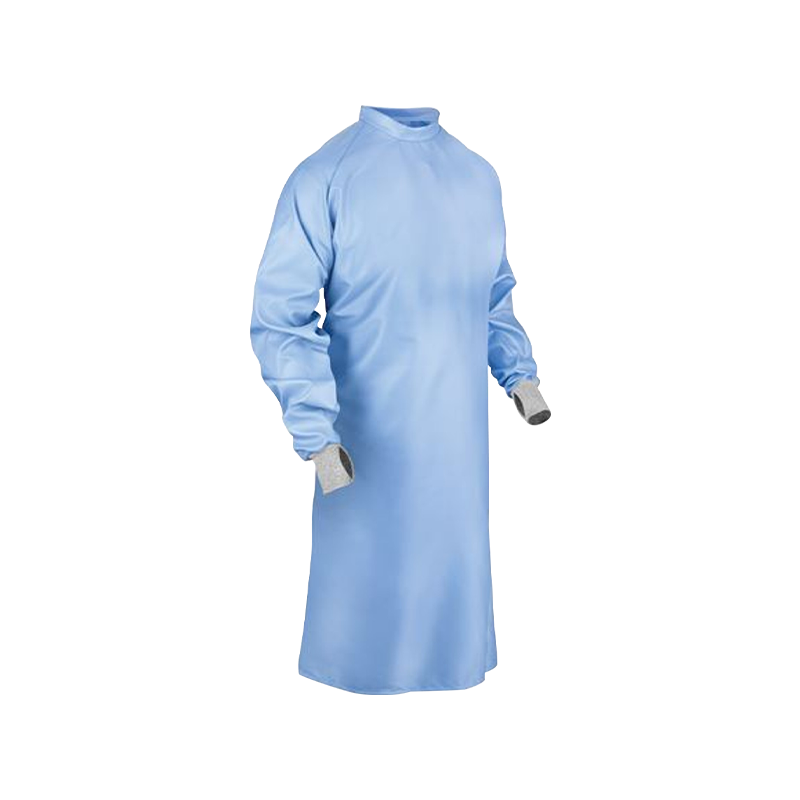
The performance of a reusable gown depends entirely on its fabric system. Most high-performance reusable gowns use one of three textile constructions.
The Association for the Advancement of Medical Instrumentation (AAMI) PB70 standard defines four protection levels for surgical and isolation gowns. Each level corresponds to a specific fluid challenge test and clinical use scenario. Procurement teams must match the gown level to the anticipated exposure risk in each department.
The table below summarizes the four AAMI PB70 levels, the test method used for each, and typical clinical applications for reusable surgical gowns fabric standards.
| AAMI Level | Test Method | Fluid Exposure Risk | Typical Clinical Use |
|---|---|---|---|
| Level 1 | AATCC 42 (Impact penetration) | Minimal | Basic patient care, standard medical units |
| Level 2 | AATCC 42 + AATCC 127 (Hydrostatic pressure) | Low to moderate | Blood draw, ICU, general surgery observation |
| Level 3 | AATCC 42 + AATCC 127 at higher pressure | Moderate to high | Arterial procedures, trauma, orthopedic surgery |
| Level 4 | ASTM F1671 (Bloodborne pathogen resistance) | High — bloodborne pathogen risk | Cardiovascular surgery, infectious disease isolation |
The reusable vs disposable medical gowns debate is not resolved by a single metric. Cost, environmental impact, infection control risk, and supply chain reliability all factor into the final decision. The table below compares both options across the criteria most relevant to B2B buyers and hospital supply departments.
| Criteria | Reusable Medical Gowns | Disposable Medical Gowns |
|---|---|---|
| Material | Woven polyester or laminated textile | Spunbond polypropylene, SMS, or polyethylene film |
| Lifecycle | 50 to 100+ wash cycles, depending on fabric and useSingle-use | e only |
| Cost per use | Lower after initial investment is amortized | Higher cumulative cost at scale |
| Environmental impact | Lower solid waste; higher water and energy use per cycle | High landfill volume; lower per-item resource use |
| Infection control risk | Managed through validated laundering protocols | Eliminated at source; no reprocessing required |
| Supply chain resilience | On-site or contracted laundry provides continuity | Vulnerable to single-use material shortages |
| Barrier consistency | Degrades with wash cycles; requires periodic testing | Consistent frothe m factory; no degradation concern |
Washable reusable isolation gowns perform correctly only when processed through a validated industrial laundry program. Consumer-grade or on-site laundry equipment does not reliably achieve the thermal disinfection parameters required for healthcare textiles.
Manufacturers typically validate their gowns for 50 to 100 wash-and-dry cycles at rated parameters. After the maximum cycle count, the fabric's hydrostatic resistance drops below the threshold required for its rated AAMI level. Facilities must track each gown's cycle count using RFID tags, barcode labels, or embroidered cycle counters. Failing to retire gowns at the end of their validated lifecycle creates a compliance and patient safety risk.
Scaling a reusable medical gown program for hospitals requires planning across three operational dimensions: inventory sizing, laundry turnaround, and contract structure.
A standard par level formula accounts for gowns in use, gowns in the soiled laundry queue, gowns in the wash cycle, gowns in the clean inventory awaiting distribution, and a safety buffer for demand spikes. Most textile service providers recommend a par ratio of 3:1 to 4:1 — meaning three to four gowns in the system for every one gown needed at any point in time.
The true cost of a reusable gown program includes initial garment purchase, laundering cost per cycle, inspection and tracking overhead, and end-of-life disposal. Published studies — including research from Practice Greenhealth — indicate that reusable surgical gowns can cost 30% to 50% less per use than comparable disposable gowns at high-volume facilities, primarily because fixed gown costs are amortized over 75 or more cycles.
Buyers sourcing gowns for regulated healthcare environments must verify compliance documentation before committing to a supplier. Key standards include the following.
The validated wash cycle limit depends on the fabric construction and the laundering parameters used. Most manufacturers validate their gowns for 50 to 100 cycles at the specified wash temperature and detergent type. Facilities must use a cycle-tracking system ,such as RFID or barcode labels, to retrieve gowns at the validated limit. Washing at temperatures above the rated maximum or using incompatible detergents can reduce the effective lifecycle significantly.
Yes, when processed correctly. Research published in the American Journal of Infection Control confirms that industrially laundered reusable gowns — when washed at thermal disinfection temperatures — achieve microbial counts equivalent to new gowns. The risk of cross-infection arises from improper handling of soiled gowns before laundering, not from the gown material itself. Facilities must enforce strict soiled-gown containment and transport protocols.
AAMI PB70 Level 3 is the minimum recommended level for most surgical procedures involving moderate fluid exposure. Level 4 is required for procedures with a high risk of bloodborne pathogen contact, such as cardiovascular surgery or operations on patients with known bloodborne infections. The surgeon's and facility's risk assessment for each procedure type should drive the final specification.
The standard approach uses a par ratio of 3:1 to 4:1 applied to the peak daily gown demand across all departments. For example, a facility using 200 gowns per day should hold 600 to 800 gowns in the total inventory to maintain a continuous supply through a 48-hour laundry cycle with an inspection buffer. Initial orders should also account for a ramp-up period during which laundry processes are being validated, and staff are trained on the new program.
With the increasing emphasis on infection control and personnel protection in medical environments, disposable medical scrub suits play an increasingl...
READ MOREWhy are material quality and barrier protection crucial in a disposable cardiovascular surgical drape pack? The efficacy of disposable cardiovascular ...
READ MOREThe Importance of Disposable Obstetrics Drapes Packs In modern delivery practices, the disposable obstetrics drapes pack has become a crucial tool for...
READ MOREThe Critical Role of Medical Gowns in Healthcare In the dynamic and often hazardous environment of a healthcare facility, medical gowns serve as a pri...
READ MORE
 This website is intended for regions outside of China.